 KSOEM
KSOEM

Articles
- Page Path
- HOME > Ann Occup Environ Med > Volume 38; 2026 > Article
- Original Article Association between shift work patterns and the incidence of prediabetes and diabetes among night shift workers: a retrospective cohort study
-
Hyundong Lee1
 , Changil Shin1, Minsun Kang2, Jae Bum Park1,2, Inchul Jeong1,2, Jaehyuk Jung1,2,*
 -
Annals of Occupational and Environmental Medicine 2026;38:e26.
DOI: https://doi.org/10.35371/aoem.2026.38.e26
Published online: July 9, 2026
1Department of Occupational and Environmental Medicine, Ajou University Hospital, Suwon, Korea
2Department of Occupational and Environmental Medicine, Ajou University School of Medicine, Suwon, Korea
- *Corresponding author: Jaehyuk Jung Department of Occupational and Environmental Medicine, Ajou University School of Medicine, 164 World cup-ro, Yeongtong-gu, Suwon 16499, Korea E-mail: 109449@aumc.ac.kr
• Received: February 24, 2026 • Revised: June 25, 2026 • Accepted: June 28, 2026
© 2026 Korean Society of Occupational & Environmental Medicine
This is an Open Access article distributed under the terms of the Creative Commons Attribution Non-Commercial License (https://creativecommons.org/licenses/by-nc/4.0/) which permits unrestricted non-commercial use, distribution, and reproduction in any medium, provided the original work is properly cited.
- 1,153 Views
- 36 Download


Abstract
-
Background Prediabetes and diabetes represent major public health challenges, and shift work has been identified as a significant occupational risk factor. While two-shift systems are gaining preference over conventional three-shift systems, evidence comparing their risks for diabetes and prediabetes remains limited. We aimed to evaluate the risk of developing prediabetes and diabetes according to shift work patterns among night shift workers.
-
Methods This retrospective cohort study analyzed 14,879 night shift workers at a tertiary hospital in Korea (2016–2022). Participants were classified into two- and three-shift patterns. Incident diabetes and prediabetes were identified based on fasting blood glucose and hemoglobin A1c levels, diagnosis, or medication use. Data were censored at shift change, diagnosis, loss to follow-up, or the end of the study. Cox proportional hazards models were used to estimate hazard ratios (HRs) and 95% confidence intervals (CIs), adjusting for demographics, lifestyle, body mass index, and occupational characteristics including working hours, consecutive night shifts, quick returns, and shift duration.
-
Results The two-shift group showed significantly higher incidence rates of diabetes and prediabetes than the three-shift group. After adjusting for covariates, two-shift work remained an independent risk factor for diabetes (adjusted HR: 1.43; 95% CI: 1.10–1.87) and prediabetes (adjusted HR: 1.34; 95% CI: 1.20–1.48). Stratified analyses indicated that the increased risk of diabetes associated with two-shift work was prominent in participants working 40 hours and 41–51 hours per week, whereas the association was not significant in those working ≥52 hours.
-
Conclusions Two-shift work was associated with a significantly higher risk of diabetes and prediabetes compared with three-shift work. Our findings highlight the need to consider specific shift schedules and their potential health effects when designing or selecting workforce systems, rather than focusing solely on productivity or preference.
BACKGROUND
Diabetes is a major public health concern affecting approximately 589 million adults aged 20–79 years worldwide,1 with its prevalence continuing to rise. Diabetes is a chronic condition characterized by hyperglycemia, resulting from inadequate insulin production, ineffective insulin utilization, or both, leading to cardiovascular and renal complications.2
Prediabetes refers to a high-risk metabolic state in which blood glucose levels are elevated but do not yet meet the diagnostic criteria for diabetes, conferring a substantial risk of progression to type 2 diabetes.3 Recent studies have revealed that the pathological processes leading to long-term diabetic complications, such as microvascular and macrovascular damage, can initiate as early as the prediabetic stage, even before a clinical diagnosis is made.4 Furthermore, prediabetes has also been associated with an increased risk of all-cause mortality, coronary heart disease, and stroke compared with normoglycemia.5 Because some individuals with prediabetes can revert to normoglycemia, the management of prediabetes is also important from a public health perspective.3
Numerous studies have established the general risk factors for diabetes, such as age, obesity, family history, and physical inactivity;6 however, considering the profound effect of occupation on lifestyle and health,7 work-related factors warrant careful consideration. Recognized occupational risk factors for diabetes include shift work,8 long working hours,9 the frequency of night shifts,10 and job strain.11 To support 24-hour operations in modern society, shift work has become increasingly common globally,12 despite being recognized as a significant risk factor for diabetes. Circadian rhythm disruption is considered a key mechanism underlying the association between shift work and diabetes risk,13 as well as metabolic syndrome.14
Although the association between shift work and diabetes is well established, studies examining the differential effects of specific shift patterns remain limited. A recent meta-analysis highlighted this research gap, pointing out that further analyses were limited by the unavailability of data concerning specific shift types and their duration.15 Existing studies have reported distinct health impacts associated with different shift systems. Some studies suggest that while two-shift systems yield higher shift satisfaction and better sleep quality,16,17 they are also linked to increased risks of metabolic syndrome and evening shift insomnia.18,19 Other studies suggest that three-shift systems are associated with lower levels of inter-shift recovery and higher chronic fatigue than two-shift systems.20,21 Despite these recognized differences in health outcomes, the specific impacts of these distinct shift patterns on the risk of diabetes remain largely unexplored.
Therefore, to better understand diabetes and prediabetes in relation to shift work patterns, using longitudinal data, we aimed to evaluate the incidence and the risk of developing prediabetes and diabetes in accordance with shift work, specifically comparing three- and two-shift schedules among night shift workers.
METHODS
This retrospective cohort study utilized health examination data from workers screened at a tertiary hospital in Suwon, Republic of Korea. In Korea, mandatory special health examinations for night shift workers were fully implemented in 2016. A worker is defined as a night shift worker if they meet either of the following criteria over a six-month period: performing continuous 8-hour shifts encompassing the hours from 00:00 to 05:00 at least four times per month on average, or accumulating an average of 60 hours or more per month within the hours of 22:00 to 06:00. We tracked health examination data from January 1, 2016, to December 31, 2022.
Initially, 31,963 workers aged ≥20 years were identified. Individuals were excluded if they underwent health examination or responded to night work questionnaire only once (n = 12,585), had missing night shift survey data (n = 51), or had diabetes at baseline (n = 628). The remaining 18,699 participants were further screened.
Participants engaged in schedules other than two-shift or three-shift systems (n = 2,623), those working <40 hours per week (n = 664), and those with missing key covariates (n = 533) were excluded. Ultimately, a total of 14,879 participants were included in the final analysis (Fig. 1). For the prediabetes analysis, 2,166 participants with prediabetes at baseline were excluded, leaving 12,713 individuals in the analytical sample.
Shift work pattern
Shift work patterns were assessed using the questionnaire item: “Please indicate your current work schedule.” The response options included three-shift work, two-shift work, every-other-day shift (24-hour shift), fixed night work, and others (irregular, etc.). Participants reporting three-shift work were assigned to three-shift workers, and those who selected two-shift work were assigned to a two-shift workers group. All other schedules were excluded.
Diabetes and prediabetes
Diabetes was defined by the presence of at least one of the following criteria: (1) self-reported diagnosis of diabetes, (2) current use of antidiabetic medication, (3) fasting plasma glucose of ≥126 mg/dL, or hemoglobin A1c (HbA1c) ≥6.5%.15 Self-reported responses were confirmed by physicians during the interviews.
Prediabetes was defined as meeting at least one of the following criteria in the absence of a diabetes diagnosis: (1) fasting plasma glucose level ≥100 mg/dL or (2) HbA1c ≥5.7%.
Body mass index (BMI) was calculated using the measured height and weight and analyzed as a continuous variable. Family history of diabetes was categorized as ‘yes’ or ‘no,’ based on the baseline questionnaire.
Lifestyle factors included smoking status, alcohol consumption, and exercise frequency. Smoking status was classified as never, former, or current, regardless of the amount of smoking. Alcohol consumption was categorized based on frequency, regardless of the type of alcohol consumed: ≤1 time per month, 2 times per month to 2 times per week, or ≥3 times per week. Exercise frequency was classified based on weekly frequency, regardless of the type of exercise, as <1 time per week, 1–4 times per week, or ≥5 times per week.
Occupational characteristics included weekly working hours, consecutive night shifts, quick return, and shiftwork duration. Weekly working hours were assessed using the question, "What are your average weekly working hours?" Responses were categorized into 40 hours, 41–51 hours, and ≥52 hours; workers reporting <40 hours were excluded. Regarding consecutive night shifts, participants were asked, "Usually, how many consecutive days did you perform night work in the past year?" and the original five options were reclassified into three groups: 1–2 days, 3–4 days, and ≥5 days. Quick returns were defined as the interval between the end of a shift and start of the next shift. Participants reporting an interval of <11 hours were classified as having quick returns, whereas those with an interval of ≥11 hours were classified as having no quick returns. Finally, the total duration of shift work was reclassified from the original categories into three groups: <5 years, 5–14 years, and ≥15 years.
Descriptive statistics were used to summarize the sociodemographic and occupational characteristics of study participants at baseline. Differences in characteristics according to shift work patterns were compared using the chi-square test for categorical variables and the independent samples t-test for continuous variables.
To investigate the longitudinal association between shift work patterns and the risk of diabetes and prediabetes, the incidence rates per 1,000 person-years were calculated. For the analysis of diabetes, data were censored at the earliest occurrence of a change in shift work pattern, diagnosis of diabetes, loss to follow-up, or the end of the study period. For the analysis of prediabetes, in addition to the exclusion criteria for diabetes, participants with a fasting blood glucose level ≥100 mg/dL or a HbA1c level ≥5.7% at baseline were excluded. Subsequently, data were censored at the earliest occurrence of a change in shift work pattern, diagnosis of prediabetes, loss to follow-up, or the end of the study period. Kaplan-Meier survival curves were generated for diabetes and prediabetes according to shift work patterns, and differences between the groups were assessed using the log-rank test. Cox proportional hazards regression models were used to estimate hazard ratios (HRs) and 95% confidence intervals (CIs). We first calculated adjusted HRs (aHRs) by controlling for age, sex, BMI, family history of diabetes, smoking status, alcohol consumption, and exercise frequency. The subsequent model was further adjusted for weekly working hours, consecutive night work days, quick return, and years of shift work. The proportional hazards assumption was visually assessed using log-minus-log survival plots, and no severe violation was observed.
Stratified analyses were performed based on weekly working hours to evaluate the risks of diabetes and prediabetes in each subgroup. All statistical analyses were performed using Statistical Package for the Social Sciences (SPSS) for Windows version 29.0 (IBM Corp., Armonk, NY, USA). R software version 4.3.2 (R Foundation for Statistical Computing, Vienna, Austria) was used for graphical visualization. Statistical significance was set at p < 0.05.
The study protocol was reviewed and approved by the Institutional Review Board of Ajou University Hospital (approval no. AJOUIRB-DB-2025-591). The requirement for informed consent was waived by the IRB owing to the retrospective nature of the study and the use of anonymized data.
RESULTS
Of the 14,879 participants included in the study, 11,803 (79.3%) were three-shift workers and 3,076 (20.7%) were two-shift workers. Significant differences were observed between the two groups for all variables except for family history of diabetes (p = 0.452).
Regarding sociodemographic characteristics, the three-shift workers were predominantly female (55.4%), whereas the two-shift workers were predominantly male (73.9%). In terms of age distribution, three-shift workers tended to be younger, with those in their 20s accounting for the largest proportion (49.9%). In contrast, age was more evenly distributed among two-shift workers. The mean BMI was higher in two-shift workers (24.21 ± 3.58 kg/m²) than in three-shift workers (23.31 ± 3.81 kg/m²).
Regarding occupational characteristics, two-shift workers tended to work longer hours than three-shift workers. Specifically, the proportion of participants working ≥52 hours per week was more than twice as high in the two-shift workers (38.4%) as in the three-shift workers (15.8%). Additionally, the prevalence of quick returns was significantly higher among two-shift workers (31.3%) than among three-shift workers (14.4%) (Table 1).
Fig. 2 illustrates the Kaplan-Meier survival curves for diabetes and prediabetes according to shift work patterns. The two-shift workers showed a significantly lower diabetes-free survival rate than the three-shift workers over the follow-up period (log-rank test, p < 0.001). A similar pattern was observed for prediabetes, with the two-shift workers exhibiting a significantly faster decline in disease-free survival than the three-shift workers (p < 0.001). These findings confirmed that the cumulative risk of developing diabetes and prediabetes was significantly higher in two-shift workers than in three-shift workers.
Of the 14,879 participants included in the diabetes analysis, 473 (3.2%) developed incident diabetes. The remaining 14,406 participants were censored due to either a change in their shift work pattern (n = 1,431, 9.6%) or the end of the follow-up or study period (n = 12,975, 87.2%). Regarding the prediabetes analysis, incident prediabetes occurred in 3,903 of the 12,713 participants (30.7%). The remaining 8,810 censored participants consisted of those who changed their shift work pattern (n = 906, 7.1%) and those who reached the end of the follow-up or study period (n = 7,904, 62.2%). During the follow-up period, the incidence rate of diabetes was 7.51 (95% CI: 6.76–8.33) per 1,000 person-years in the three-shift workers and 17.48 (95% CI: 14.65–20.86) per 1,000 person-years in the two-shift workers, indicating a substantially higher incidence among two-shift workers. In the unadjusted analysis, the crude HR for diabetes in the two-shift workers compared with the three-shift workers was 2.68 (95% CI: 2.16–3.30). In the fully adjusted model, which controlled for all potential confounders, including age, sex, BMI, family history of diabetes, lifestyle factors, and occupational characteristics, two-shift workers had a significantly higher risk of developing diabetes compared with three-shift workers (aHR: 1.43; 95% CI: 1.10–1.87). A similar trend was observed for prediabetes. The incidence rate was higher in the two-shift workers (160.41 per 1,000 person-years) than in the three-shift workers (90.07 per 1,000 person-years). In the fully adjusted model, after controlling for all covariates, two-shift work remained a risk factor for prediabetes, showing a significantly higher risk compared with three-shift work (aHR: 1.34; 95% CI: 1.20–1.48) (Table 2).
Stratified analyses were conducted to investigate whether the association between shift work patterns and incidence of diabetes varied according to weekly working hours. Among participants working 40 hours per week (aHR: 1.84; 95% CI: 1.04–3.26) and those working 41–51 hours per week (aHR: 1.68; 95% CI: 1.08–2.61), two-shift work was significantly associated with an increased risk of diabetes compared with three-shift work. Among those working ≥52 hours per week, although a higher risk was observed among two-shift workers; the association was not statistically significant (aHR: 1.15; 95% CI: 0.76–1.75) (Table 3).
We further examined the risk of prediabetes across different weekly working hours. A significant association was observed in the 41–51 hours subgroup, in which two-shift workers faced a higher risk (aHR: 1.52; 95% CI: 1.31–1.77). While two-shift workers in the ≥52-hours group also exhibited a tendency toward increased risk (aHR: 1.21; 95% CI: 1.00–1.46), no significant difference was observed in the 40-hour group (aHR: 1.20; 95% CI: 0.93–1.56) (Table 4).
When evaluating the combined categories of shift work patterns and quick returns, two-shift workers without quick returns were significantly associated with a higher risk of diabetes compared to the reference group of three-shift workers without quick returns in the fully adjusted model (aHR: 1.51; 95% CI: 1.13–2.02). No significant associations were observed among the groups with quick returns (Supplementary Table 1). Regarding the incidence of prediabetes, a significantly higher risk was associated with both two-shift workers without quick returns (aHR: 1.35; 95% CI: 1.20–1.52) and two-shift workers with quick returns (aHR: 1.32; 95% CI: 1.14–1.53) compared to the same reference group (Supplementary Table 2). Furthermore, in analyses stratified by sex, the significant association between two-shift work and a higher risk of diabetes was observed only in males (aHR: 1.38; 95% CI: 1.01–1.87). In contrast, for prediabetes, two-shift work was significantly associated with a higher risk in both males (aHR: 1.32; 95% CI: 1.16–1.50) and females (aHR: 1.47; 95% CI: 1.21–1.78) compared to their respective three-shift worker reference groups (Supplementary Table 3). In age-stratified analyses, the significant association between two-shift work and a higher risk of diabetes was exclusively observed in the youngest age group of 20–29 years (aHR: 2.75; 95% CI: 1.26–5.97). For prediabetes, two-shift work was significantly associated with a higher risk in the 20–29 (aHR: 1.34; 95% CI: 1.09–1.65), 30–39 (aHR: 1.42; 95% CI: 1.18–1.72), and 40–49 (aHR: 1.30; 95% CI: 1.05–1.62) age groups, but this association was not significant in those aged 50 years or older (Supplementary Table 4).
DISCUSSION
This study investigated the longitudinal association between shift work patterns and the incidence of diabetes and prediabetes among night shift workers using data from special health examinations. We characterized the sociodemographic and occupational profiles of shift workers and applied Cox proportional hazards models to evaluate these associations. Stratified and subgroup analyses were performed based on weekly working hours. The analysis revealed that two-shift workers were associated with a higher risk of diabetes and prediabetes compared to three-shift workers. These findings remained consistent after adjustment for sociodemographic and occupational characteristics. This observation aligns with prior studies reporting that two-shift workers are at a higher risk of metabolic syndrome22 compared with three-shift workers.
These findings can be explained by the following mechanisms: First, although two-shift systems provide more days off work, they may induce acute sleep deprivation. A previous study has indicated that the two-shift pattern reduces sleep duration on night-shift workdays.23 This is likely because the absolute time available for sleep is restricted between consecutive shifts after accounting for commuting and daily living activities, potentially leading to acute sleep deprivation. Sleep deprivation of <1 week can result in marked alterations in metabolic and endocrine functions and reduce insulin sensitivity.22,24 Even partial sleep restriction for a single day has been shown to decrease insulin sensitivity.25 Consequently, the accumulated sleep debt during consecutive two-shift workdays may contribute to elevated blood glucose levels. Furthermore, a single 12-hour shift can increase physical fatigue compared with an 8-hour shift.26 Second, increased nocturnal eating during two-shift work may exacerbate circadian disruption. Food intake at night poses metabolic challenges because the body is biologically prepared for sleep during this period,27 as characterized by reduced glucose tolerance28 and delayed gastric emptying.29 Two-shift workers experience a prolonged duration of night work per shift, which may increase the likelihood of nocturnal eating. Nocturnal eating, which may conflict with normal physiological rhythms, is associated with an increased risk of type 2 diabetes.30 Night shift workers are known to often skip meals and increase snacking frequency.31 Since workplace cafeterias are frequently closed at night, workers frequently rely on vending machines,32 consuming processed foods high in saturated fat, sugar, and sodium. Additionally, two-shift workers may rely more on caffeine to endure long night shifts,33 which can further disrupt circadian rhythms and impair sleep quality. Also, two-shift work reduces sleep duration, and individuals with short sleep duration may irregularly consume high-calorie meals and snacks.34
The lack of statistical significance for diabetes risk in the ≥52-hours group can be explained by healthy workers and ceiling effects. Working ≥52 hours is an exceptionally demanding schedule; thus, it is highly probable that workers with prediabetes or poor health could not sustain such long hours in a two-shift system and were transferred out of this group. Consequently, the remaining workers in the two-shift ≥52-hours group likely represent a healthier subpopulation, potentially leading to an underestimation of the true risk of diabetes associated with two-shift work. Regarding the ceiling effect, participants working ≥52 hours are already at a significantly elevated risk of developing diabetes.35,36 Long working hours are known to induce circadian disruption and sleep deprivation.37 Since this group is subject to a high baseline risk regardless of the shift type (three-shift or two-shift), the incremental risk increase attributable specifically to two-shift work may have been obscured. The non-significant result for prediabetes risk in the 40-hour group may be attributed to structural irregularities. Two-shift systems typically involve 12-hour shifts; adhering to a 40-hour workweek standard requires schedule rotation to maintain the weekly average. This necessitates varying the number of working days per week, making it an uncommon work arrangement. Therefore, it is possible that unmeasured confounding variables influenced the results in this subgroup. In additional analysis, participants were categorized into four groups: three-shift without quick return, two-shift without quick return, three-shift with quick return, and two-shift with quick return. Our analysis revealed that the risk of incident diabetes and prediabetes was higher in the two-shift without quick return group compared to the three-shift without quick return group. Therefore, it is plausible that the two-shift system itself, even when adequate inter-shift rest is guaranteed, increases the risk of diabetes and prediabetes compared to the three-shift system, through acute sleep deprivation and increased nocturnal eating.
In the sex-stratified analysis, the significant association between two-shift work and diabetes risk was exclusively observed in males. Consistent with a previous meta-analysis, the underlying biological mechanisms of shift work and diabetes may differ between the sexes, as circadian disruption in men can alter androgen secretion and thereby elevate the risk of diabetes.38 Furthermore, the lack of a significant association among females requires cautious interpretation due to limited statistical power. Specifically, the proportion of female two-shift workers was relatively small, resulting in a low number of incident diabetes cases (n = 23) in this group. This interpretation may be corroborated by the prediabetes results, which had a higher incidence and showed significant associations in both sexes. In age-stratified analyses, the association between two-shift work and diabetes risk was most prominent in the youngest group but absent in those aged ≥50 years. Consistent with previous research, this finding suggests that the adverse effects of circadian misalignment may be more easily detected among younger workers, who typically have a lower baseline risk of diabetes.39 Conversely, the attenuated associations in older workers likely reflect the healthy worker survivor effect, where vulnerable individuals transition out of shift work early. Furthermore, age-related changes in the circadian system may render older individuals less sensitive to rhythm disruption, which could dilute the effects of shift work on metabolic health.40,41
This study has several limitations. First, there was a geographical limitation, as the data were obtained from health screenings conducted at a single hospital. However, this limitation was partially mitigated by including data from mobile health screening conducted across various regions. Second, while other shift work patterns such as four-shift rotations or every-other-day shifts were excluded owing to limited sample sizes, a major limitation remains regarding the unmeasured heterogeneity within the included two-shift and three-shift groups. Even within the same shift system, there can be substantial variations in industry types, specific occupational categories, and work environments. In particular, we were unable to capture detailed work schedules, such as the exact number of teams involved in the rotation system or the specific timing of scheduled off days. Because the current dataset lacked such granular information, we could not adjust for these critical occupational confounders that may influence health. To partially address this gap, we made every effort to adjust for the limited occupational data available from the special health examinations, specifically incorporating weekly working hours, consecutive night shifts, quick returns, and the total duration of shift work into our analytical models. Third, other potential confounding variables, including the proportion of post-night-shift examinations, socioeconomic status, educational level, and dietary habits, were not fully accounted for. Nevertheless, we adjusted for critical personal variables, including BMI, smoking, alcohol consumption, and exercise frequency, to minimize residual confounding as much as possible. Fourth, owing to the analytical approach, participant characteristics were defined based on baseline data; thus, changes in personal or occupational characteristics during the follow-up period could not be incorporated. Potential selection bias arising from loss to follow-up during the observation period cannot be completely ruled out. Furthermore, not treating shift work pattern changes as a time-varying exposure may have resulted in selection bias, particularly if shift pattern transitions were influenced by the participants' health or occupational status during follow-up. Despite our efforts to minimize this by censoring follow-up upon a change in shift pattern, we cannot eliminate the bias caused by workers changing their shifts. Fifth, there is a potential misclassification of fasting blood glucose levels due to undetected noncompliance with fasting rules. Although the institution made maximum efforts to ensure accuracy by individually confirming that every participant fasted for eight hours before the examination, it is realistically impossible to screen out all inaccurate reporting.
Despite these limitations, this study has several strengths. It utilized a large-scale sample based on actual health examination data to ensure high representativeness. Furthermore, unlike cross-sectional studies, this study employed a retrospective cohort design with long-term follow-up and longitudinal analysis, enabling a more reliable risk estimation. Additionally, the study was conducted exclusively on verified night shift workers and, unlike previous studies,18,42 it included workers from diverse occupations. Compared with prior research comparing three-shift and two-shift work, we adjusted for additional confounding variables. A key strength of this study is that we confirmed the effects of shift work patterns on diabetes and prediabetes even after stratification by weekly working hours, a factor known to have a strong influence on diabetes.
CONCLUSIONS
This study suggests that two-shift work is associated with an elevated risk of diabetes and prediabetes compared to three-shift work. As this study compared risks exclusively among shift workers without a day-working group, this elevated risk is relative and does not imply that three-shift work is metabolically safe. This study highlights that potential health effects need to be considered when selecting or transitioning to shift work systems beyond productivity and worker preferences.
Abbreviations
aHR
adjusted HR
BMI
body mass index
CI
confidence interval
cHR
crude hazard ratio
HbA1c
hemoglobin A1c
HR
hazard ratio
SD
standard deviation
-
Competing interests
Inchul Jeong, contributing editor of the Annals of Occupational and Environmental Medicine, was not involved in the editorial evaluation or decision to publish this article. All remaining authors have declared no conflicts of interest.
-
Author contributions
Conceptualization: Jeong I. Data curation: Kang M, Shin C. Formal analysis: Lee H. Writing - original draft: Lee H. Writing - review & editing: Park JB, Jeong I, Jung J.
NOTES
SUPPLEMENTARY MATERIAL
Supplementary Table 1.
Hazard ratios of the incidence of diabetes in relation to the shift work pattern and quick return.
Supplementary Table 2.
Hazard ratios of the incidence of prediabetes in relation to the shift work pattern and quick return.
Supplementary Table 3.
Hazard ratios of the incidence of diabetes and prediabetes in relation to the shift work pattern stratified according to sex.
Supplementary Table 4.
Hazard ratios of the incidence of diabetes and prediabetes in relation to the shift work pattern stratified according to age.
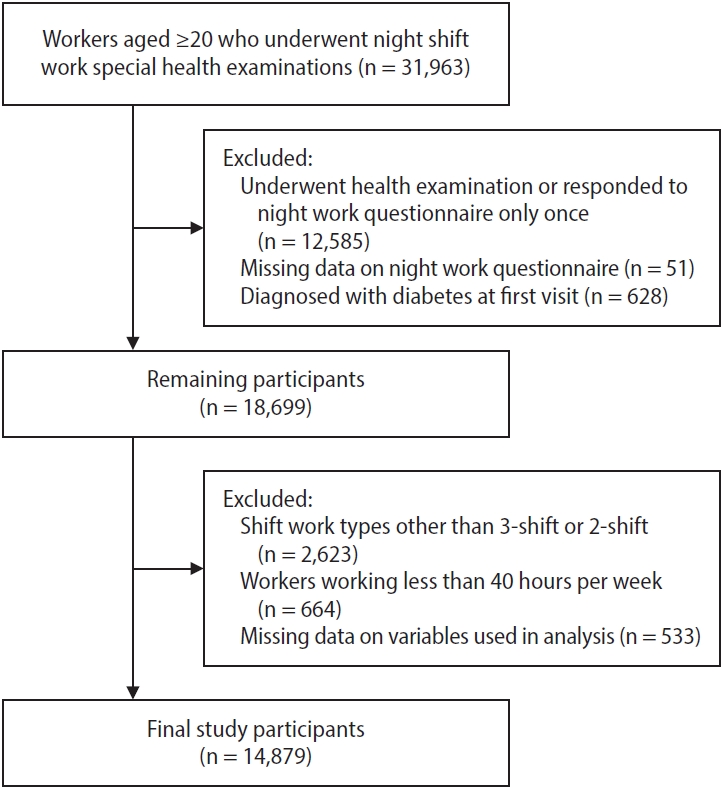
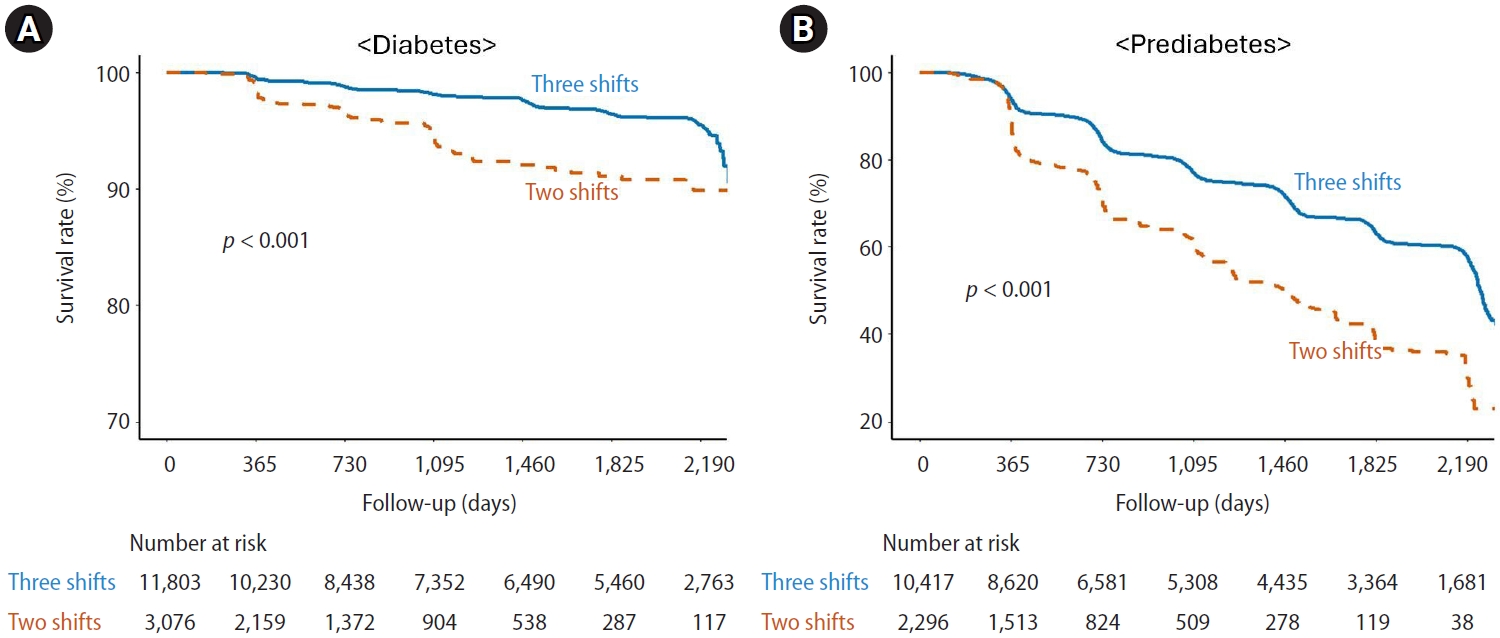
Table 1.
General characteristics of study participants according to the shift work pattern
Table 2.
Hazard ratios of incidence of diabetes and prediabetes according to the shift work pattern
| Shift work pattern | Incidence per 1,000 person-years (95% CI) | No. of cases | Follow-up time (years) | cHR (95% CI) | aHR (95% CI) | |
|---|---|---|---|---|---|---|
| Model 1a | Model 2b | |||||
| Incidence of diabetes | 8.81 (8.05–9.64) | 473 | 53,669.80 | |||
| Three-shift work | 7.51 (6.76–8.33) | 350 | 46,635.20 | Ref. | Ref. | Ref. |
| Two-shift work | 17.48 (14.65–20.86) | 123 | 7,034.60 | 2.68 (2.16–3.30) | 1.47 (1.17–1.85) | 1.43 (1.10–1.87) |
| Incidence of prediabetes | 98.03 (95.00–101.16) | 3,903 | 39,814.00 | |||
| Three-shift work | 90.07 (86.99–93.25) | 3,180 | 35,306.80 | Ref. | Ref. | Ref. |
| Two-shift work | 160.41 (149.13–172.54) | 723 | 4,507.20 | 2.02 (1.86–2.20) | 1.36 (1.24–1.48) | 1.34 (1.20–1.48) |
CI: confidence interval; cHR: crude hazard ratio; aHR: adjusted hazard ratio; BMI: body mass index.
aModel 1 adjusted for age, sex, BMI, family history of diabetes, smoking status, alcohol consumption, and exercise frequency;
bModel 2 adjusted for age, sex, BMI, family history of diabetes, smoking status, alcohol consumption, exercise frequency, weekly working hours, consecutive night work days, quick return, and years of shift work.
Table 3.
Hazard ratios of the incidence of diabetes in relation to the shift work pattern, stratified according to weekly working hours
| Weekly working hours | Shift work pattern | Incidence per 1,000 person-years (95% CI) | No. of cases | Follow-up time (years) | cHR (95% CI) | aHR (95% CI) | |
|---|---|---|---|---|---|---|---|
| Model 1a | Model 2b | ||||||
| 40 hours | 11.63 (9.44–14.34) | 88 | 7,564.00 | ||||
| Three-shift work | 10.47 (8.27–13.26) | 69 | 6,589.90 | Ref. | Ref. | Ref. | |
| Two-shift work | 19.50 (12.44–30.58) | 19 | 974.10 | 2.19 (1.31–3.66) | 1.95 (1.13–3.35) | 1.84 (1.04–3.26) | |
| 41–51 hours | 6.82 (6.05–7.69) | 267 | 39,152.10 | ||||
| Three-shift work | 6.15 (5.39–7.01) | 221 | 35,946.50 | Ref. | Ref. | Ref. | |
| Two-shift work | 14.35 (10.75–19.16) | 46 | 3,205.60 | 2.87 (2.07–3.97) | 1.61 (1.12–2.32) | 1.68 (1.08–2.61) | |
| ≥52 hours | 16.97 (14.17–20.32) | 118 | 6,953.70 | ||||
| Three-shift work | 14.64 (11.37–18.85) | 60 | 4,098.80 | Ref. | Ref. | Ref. | |
| Two-shift work | 20.32 (15.71–26.28) | 58 | 2,854.90 | 1.44 (1.00–2.08) | 0.99 (0.68–1.43) | 1.15 (0.76–1.75) | |
CI: confidence interval; cHR: crude hazard ratio; aHR: adjusted hazard ratio; BMI: body mass index.
aModel 1 adjusted for age, sex, BMI, family history of diabetes, smoking status, alcohol consumption, and exercise frequency;
bModel 2 adjusted for age, sex, BMI, family history of diabetes, smoking status, alcohol consumption, exercise frequency, consecutive night work days, quick return, and years of shift work.
Table 4.
Hazard ratios of the incidence of prediabetes in relation to the shift work pattern, stratified according to weekly working hours
| Weekly working hours | Shift work pattern | Incidence per 1000 person-years (95% CI) | No. of cases | Follow-up time (years) | cHR (95% CI) | aHR (95% CI) | |
|---|---|---|---|---|---|---|---|
| Model 1a | Model 2b | ||||||
| 40 hours | 101.73 (93.32–110.70) | 539 | 5,298.18 | ||||
| Three-shift work | 97.86 (89.09–107.25) | 457 | 4,670.12 | Ref. | Ref. | Ref. | |
| Two-shift work | 130.56 (103.84–162.06) | 82 | 628.06 | 1.40 (1.10–1.78) | 1.15 (0.90–1.48) | 1.20 (0.93–1.56) | |
| 41–51 hours | 92.31 (88.89–95.83) | 2,750 | 29,790.51 | ||||
| Three-shift work | 87.20 (83.76–90.75) | 2,417 | 27,716.68c | Ref. | Ref. | Ref. | |
| Two-shift work | 160.57 (143.79–178.78) | 333 | 2,073.84c | 2.18 (1.94–2.45) | 1.51 (1.33–1.72) | 1.52 (1.31–1.77) | |
| ≥52 hours | 129.94 (119.86–140.64) | 614 | 4,725.32 | ||||
| Three-shift work | 104.79 (93.38–117.22) | 306 | 2,920.00 | Ref. | Ref. | Ref. | |
| Two-shift work | 170.61 (152.08–190.76) | 308 | 1,805.32 | 1.76 (1.50–2.07) | 1.17 (0.99–1.40) | 1.21 (1.00–1.46) | |
CI: confidence interval; cHR: crude hazard ratio; aHR: adjusted hazard ratio; BMI: body mass index.
aModel 1 adjusted for age, sex, BMI, family history of diabetes, smoking status, alcohol consumption, and exercise frequency;
bModel 2 adjusted for age, sex, BMI, family history of diabetes, smoking status, alcohol consumption, exercise frequency, consecutive night work days, quick return, and years of shift work.
cThe sum of individual categories may not equal the total due to rounding.
- 1. Duncan BB, Magliano DJ, Boyko EJ. IDF Diabetes Atlas 11th edition 2025: global prevalence and projections for 2050. Nephrol Dial Transplant 2025;41(1):7–9.ArticlePubMedPDF
- 2. Farmaki P, Damaskos C, Garmpis N, Garmpi A, Savvanis S, Diamantis E. Complications of the type 2 diabetes mellitus. Curr Cardiol Rev 2020;16(4):249–51.ArticlePubMedPMCPDF
- 3. Tabak AG, Herder C, Rathmann W, Brunner EJ, Kivimaki M. Prediabetes: a high-risk state for diabetes development. Lancet 2012;379(9833):2279–90.ArticlePubMedPMC
- 4. Brannick B, Dagogo-Jack S. Prediabetes and cardiovascular disease: pathophysiology and interventions for prevention and risk reduction. Endocrinol Metab Clin North Am 2018;47(1):33–50.ArticlePubMedPMC
- 5. Cai X, Zhang Y, Li M, Wu JH, Mai L, Li J, et al. Association between prediabetes and risk of all cause mortality and cardiovascular disease: updated meta-analysis. BMJ 2020;370:m2297.ArticlePubMedPMC
- 6. American Diabetes Association Professional Practice Committee. 2. Diagnosis and classification of diabetes: standards of care in diabetes-2025. Diabetes Care 2025;48(1 Suppl 1):S27–49.ArticlePubMedPMC
- 7. Burgard SA, Lin KY. Bad jobs, bad health? How work and working conditions contribute to health disparities. Am Behav Sci 2013;57(8):1105–27.ArticlePubMedPMCPDF
- 8. Xie F, Hu K, Fu R, Zhang Y, Xiao K, Tu J. Association between night shift work and the risk of type 2 diabetes mellitus: a cohort-based meta-analysis. BMC Endocr Disord 2024;24(1):268.ArticlePubMedPMCPDF
- 9. Keller E, Chen L, Gao F, Li J. Risk for diabetes from long working hours and night work in the United States: prospective associations and machine learning techniques. Saf Health Work 2025;16(3):355–60.ArticlePubMedPMC
- 10. Vetter C, Dashti HS, Lane JM, Anderson SG, Schernhammer ES, Rutter MK, et al. Night shift work, genetic risk, and type 2 diabetes in the UK Biobank. Diabetes Care 2018;41(4):762–9.ArticlePubMedPMCPDF
- 11. Nyberg ST, Fransson EI, Heikkila K, Ahola K, Alfredsson L, Bjorner JB, et al. Job strain as a risk factor for type 2 diabetes: a pooled analysis of 124,808 men and women. Diabetes Care 2014;37(8):2268–75.ArticlePubMedPMCPDF
- 12. Maul D. The International Labour Organization: 100 Years of Global Social Policy. Berlin, Germany: Walter de Gruyter GmbH; 2019.
- 13. Gao Y, Gan T, Jiang L, Yu L, Tang D, Wang Y, et al. Association between shift work and risk of type 2 diabetes mellitus: a systematic review and dose-response meta-analysis of observational studies. Chronobiol Int 2020;37(1):29–46.ArticlePubMed
- 14. Yang X, Di W, Zeng Y, Liu D, Han M, Qie R, et al. Association between shift work and risk of metabolic syndrome: a systematic review and meta-analysis. Nutr Metab Cardiovasc Dis 2021;31(10):2792–9.ArticlePubMed
- 15. Wu QJ, Sun H, Wen ZY, Zhang M, Wang HY, He XH, et al. Shift work and health outcomes: an umbrella review of systematic reviews and meta-analyses of epidemiological studies. J Clin Sleep Med 2022;18(2):653–62.ArticlePubMedPMC
- 16. Hong J, Kim M, Suh EE, Cho S, Jang S. Comparison of fatigue, quality of life, turnover intention, and safety incident frequency between 2-shift and 3-shift Korean nurses. Int J Environ Res Public Health 2021;18(15):7953.ArticlePubMedPMC
- 17. Costa G, Anelli MM, Castellini G, Fustinoni S, Neri L. Stress and sleep in nurses employed in "3 x 8" and "2 x 12" fast rotating shift schedules. Chronobiol Int 2014;31(10):1169–78.ArticlePubMed
- 18. Chae MJ, Choi SJ. Comparison of shift satisfaction, sleep, fatigue, quality of life, and patient safety incidents between two-shift and three-shift intensive care unit nurses. J Korean Crit Care Nurs 2020;13(2):1–11.ArticlePDF
- 19. Flo E, Pallesen S, Akerstedt T, Mageroy N, Moen BE, Gronli J, et al. Shift-related sleep problems vary according to work schedule. Occup Environ Med 2013;70(4):238–45.ArticlePubMed
- 20. Yamaguchi S, Winwood PC, Yano R. Chronic fatigue and recovery among nurses working two-shift and three-shift rotations. Collegian 2023;30(6):786–94.Article
- 21. Oh JI, Yim HW. Association between rotating night shift work and metabolic syndrome in Korean workers: differences between 8-hour and 12-hour rotating shift work. Ind Health 2018;56(1):40–8.ArticlePubMedPMC
- 22. Buxton OM, Pavlova M, Reid EW, Wang W, Simonson DC, Adler GK. Sleep restriction for 1 week reduces insulin sensitivity in healthy men. Diabetes 2010;59(9):2126–33.ArticlePubMedPMCPDF
- 23. Seo YJ, Matsumoto K, Park YM, Shinkoda H, Noh TJ. The relationship between sleep and shift system, age and chronotype in shift workers. Biol Rhythm Res 2000;31(5):559–79.Article
- 24. Spiegel K, Leproult R, Van Cauter E. Impact of sleep debt on metabolic and endocrine function. Lancet 1999;354(9188):1435–9.ArticlePubMed
- 25. Donga E, van Dijk M, van Dijk JG, Biermasz NR, Lammers GJ, van Kralingen KW, et al. A single night of partial sleep deprivation induces insulin resistance in multiple metabolic pathways in healthy subjects. J Clin Endocrinol Metab 2010;95(6):2963–8.ArticlePubMed
- 26. Dall'Ora C, Ball J, Recio-Saucedo A, Griffiths P. Characteristics of shift work and their impact on employee performance and wellbeing: a literature review. Int J Nurs Stud 2016;57:12–27.ArticlePubMed
- 27. Akerstedt T. Shift work and disturbed sleep/wakefulness. Occup Med (Lond) 2003;53(2):89–94.ArticlePubMed
- 28. Van Cauter E, Shapiro ET, Tillil H, Polonsky KS. Circadian modulation of glucose and insulin responses to meals: relationship to cortisol rhythm. Am J Physiol 1992;262(4 Pt 1):E467–75.ArticlePubMed
- 29. Goo RH, Moore JG, Greenberg E, Alazraki NP. Circadian variation in gastric emptying of meals in humans. Gastroenterology 1987;93(3):515–8.ArticlePubMed
- 30. Mason IC, Qian J, Adler GK, Scheer FA. Impact of circadian disruption on glucose metabolism: implications for type 2 diabetes. Diabetologia 2020;63(3):462–72.ArticlePubMedPMCPDF
- 31. Lin TT, Guo YL, Gordon CJ, Chen YC, Wu HC, Cayanan E, et al. Snacking among shiftwork nurses related to non-optimal dietary intake. J Adv Nurs 2022;78(11):3629–40.ArticlePubMedPMC
- 32. Gupta CC, Coates AM, Dorrian J, Banks S. The factors influencing the eating behaviour of shiftworkers: what, when, where and why. Ind Health 2019;57(4):419–53.ArticlePubMedPMC
- 33. Schweitzer PK, Randazzo AC, Stone K, Erman M, Walsh JK. Laboratory and field studies of naps and caffeine as practical countermeasures for sleep-wake problems associated with night work. Sleep 2006;29(1):39–50.ArticlePubMed
- 34. Hemmer A, Mareschal J, Dibner C, Pralong JA, Dorribo V, Perrig S, et al. The effects of shift work on cardio-metabolic diseases and eating patterns. Nutrients 2021;13(11):4178.ArticlePubMedPMC
- 35. Lee Y, Seo E, Lee W. Long working hours and the risk of glucose intolerance: a cohort study. Int J Environ Res Public Health 2022;19(18):11831.ArticlePubMedPMC
- 36. Kivimaki M, Virtanen M, Kawachi I, Nyberg ST, Alfredsson L, Batty GD, et al. Long working hours, socioeconomic status, and the risk of incident type 2 diabetes: a meta-analysis of published and unpublished data from 222 120 individuals. Lancet Diabetes Endocrinol 2015;3(1):27–34.ArticlePubMedPMC
- 37. Wong K, Chan AH, Ngan SC. The effect of long working hours and overtime on occupational health: a meta-analysis of evidence from 1998 to 2018. Int J Environ Res Public Health 2019;16(12):2102.ArticlePubMedPMC
- 38. Gan Y, Yang C, Tong X, Sun H, Cong Y, Yin X, et al. Shift work and diabetes mellitus: a meta-analysis of observational studies. Occup Environ Med 2015;72(1):72–8.ArticlePubMed
- 39. Vimalananda VG, Palmer JR, Gerlovin H, Wise LA, Rosenzweig JL, Rosenberg L, et al. Night-shift work and incident diabetes among African-American women. Diabetologia 2015;58(4):699–706.ArticlePubMedPMCPDF
- 40. Duncan MJ, Prochot JR, Cook DH, Tyler Smith J, Franklin KM. Influence of aging on Bmal1 and Per2 expression in extra-SCN oscillators in hamster brain. Brain Res 2013;1491:44–53.ArticlePubMedPMC
- 41. Nakamura TJ, Takasu NN, Nakamura W. The suprachiasmatic nucleus: age-related decline in biological rhythms. J Physiol Sci 2016;66(5):367–74.ArticlePubMedPMCPDF
- 42. Dall'Ora C, Griffiths P, Ball J, Simon M, Aiken LH. Association of 12 h shifts and nurses' job satisfaction, burnout and intention to leave: findings from a cross-sectional study of 12 European countries. BMJ Open 2015;5(9):e008331.ArticlePubMedPMC
REFERENCES
Figure & Data
REFERENCES
Citations
Citations to this article as recorded by 
 Cite
Cite XML Download
Association between shift work patterns and the incidence of prediabetes and diabetes among night shift workers: a retrospective cohort study
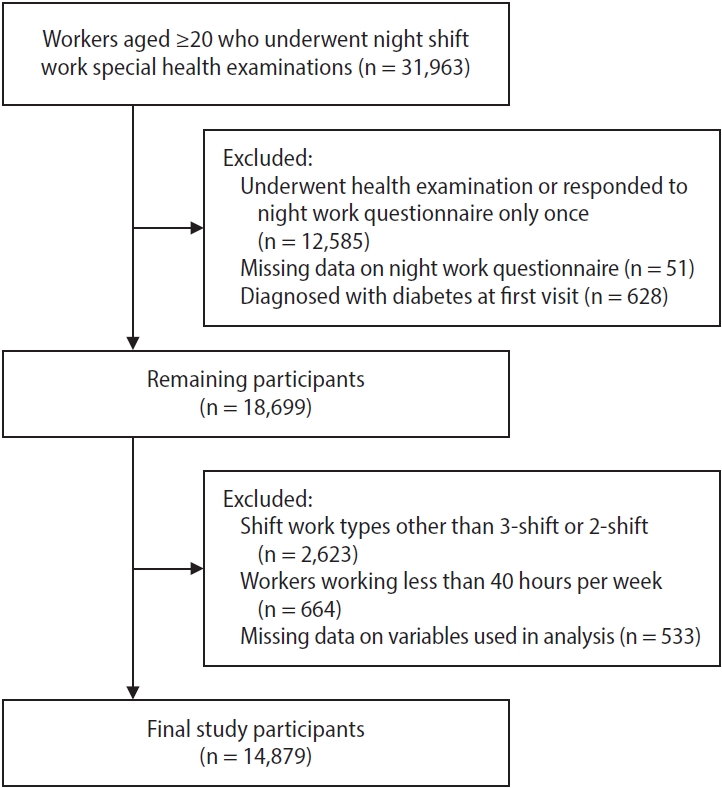
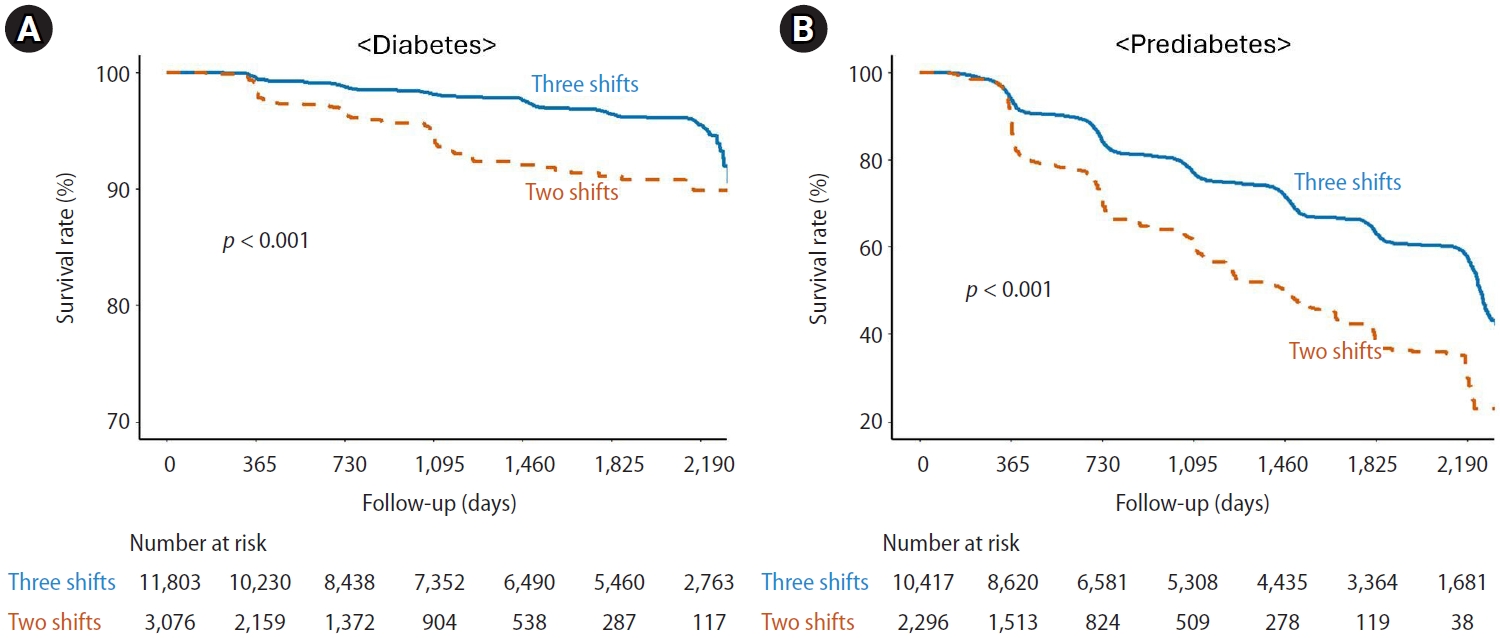
Fig. 1. Flowchart of participant selection.
Fig. 2. Kaplan-Meier survival curves for diabetes (A) and prediabetes (B).
Fig. 1.
Fig. 2.
Association between shift work patterns and the incidence of prediabetes and diabetes among night shift workers: a retrospective cohort study
| Total (n = 14,879) | Three-shift work (n = 11,803) | Two-shift work (n = 3,076) | p-value | |
|---|---|---|---|---|
| Sex | <0.001 | |||
| Male | 7,539 (50.7) | 5,266 (44.6) | 2,273 (73.9) | |
| Female | 7,340 (49.3) | 6,537 (55.4) | 803 (26.1) | |
| Age (years) | <0.001 | |||
| 20–29 | 6,746 (45.3) | 5,888 (49.9) | 858 (27.9) | |
| 30–39 | 4,803 (32.3) | 4,014 (34.0) | 789 (25.7) | |
| 40–49 | 2,034 (13.7) | 1,265 (10.7) | 769 (25.0) | |
| ≥50 | 1,296 (8.7) | 636 (5.4) | 660 (21.5) | |
| BMI (kg/m2) | 23.50 ± 3.78 | 23.31 ± 3.81 | 24.21 ± 3.58 | <0.001 |
| Family history of diabetes | 0.452 | |||
| No | 13,354 (89.8) | 10,582 (89.7) | 2,772 (90.1) | |
| Yes | 1,525 (10.2) | 1,221 (10.3) | 304 (9.9) | |
| Smoking status | <0.001 | |||
| Never | 9,128 (61.4) | 7,786 (66.0) | 1,342 (43.6) | |
| Former | 2,182 (14.7) | 1,589 (13.5) | 593 (19.3) | |
| Current | 3,569 (24.0) | 2,428 (20.6) | 1,141 (37.1) | |
| Alcohol consumption | <0.001 | |||
| ≤1/month | 5,966 (40.1) | 4,688 (39.7) | 1,278 (41.5) | |
| 2/month–2/week | 5,308 (35.7) | 4,299 (36.4) | 1,009 (32.8) | |
| ≥3/week | 3,605 (24.2) | 2,816 (23.9) | 789 (25.7) | |
| Exercise frequency | <0.001 | |||
| ≥5/week | 6,596 (44.3) | 5,474 (46.4) | 1,122 (36.5) | |
| 1–4/week | 5,929 (39.8) | 4,646 (39.4) | 1,283 (41.7) | |
| <1/week | 2,354 (15.8) | 1,683 (14.3) | 671 (21.8) | |
| Weekly working hours | <0.001 | |||
| 40 hours | 2,474 (16.6) | 2,031 (17.2) | 443 (14.4) | |
| 41–51 hours | 10,060 (67.6) | 8,607 (72.9) | 1,453 (47.2) | |
| ≥52 hours | 2,345 (15.8) | 1,165 (9.9) | 1,180 (38.4) | |
| Consecutive night work days | <0.001 | |||
| 1 or 2 days | 3,570 (24.0) | 2,748 (23.3) | 822 (26.7) | |
| 3 or 4 days | 2,406 (16.2) | 1,337 (11.3) | 1,069 (34.8) | |
| ≥5 days | 8,903 (59.8) | 7,718 (65.4) | 1,185 (38.5) | |
| Quick return | <0.001 | |||
| No | 12,730 (85.6) | 10,618 (90.0) | 2,112 (68.7) | |
| Yes | 2,149 (14.4) | 1,185 (10.0) | 964 (31.3) | |
| Years of shift work | <0.001 | |||
| <5 years | 6,860 (46.1) | 5,108 (43.3) | 1,752 (57.0) | |
| 5–14 years | 5,843 (39.3) | 4,967 (42.1) | 876 (28.5) | |
| ≥15 years | 2,176 (14.6) | 1,728 (14.6) | 448 (14.6) |
| Shift work pattern | Incidence per 1,000 person-years (95% CI) | No. of cases | Follow-up time (years) | cHR (95% CI) | aHR (95% CI) | |
|---|---|---|---|---|---|---|
| Model 1 |
Model 2 |
|||||
| Incidence of diabetes | 8.81 (8.05–9.64) | 473 | 53,669.80 | |||
| Three-shift work | 7.51 (6.76–8.33) | 350 | 46,635.20 | Ref. | Ref. | Ref. |
| Two-shift work | 17.48 (14.65–20.86) | 123 | 7,034.60 | 2.68 (2.16–3.30) | 1.47 (1.17–1.85) | 1.43 (1.10–1.87) |
| Incidence of prediabetes | 98.03 (95.00–101.16) | 3,903 | 39,814.00 | |||
| Three-shift work | 90.07 (86.99–93.25) | 3,180 | 35,306.80 | Ref. | Ref. | Ref. |
| Two-shift work | 160.41 (149.13–172.54) | 723 | 4,507.20 | 2.02 (1.86–2.20) | 1.36 (1.24–1.48) | 1.34 (1.20–1.48) |
| Weekly working hours | Shift work pattern | Incidence per 1,000 person-years (95% CI) | No. of cases | Follow-up time (years) | cHR (95% CI) | aHR (95% CI) | |
|---|---|---|---|---|---|---|---|
| Model 1 |
Model 2 |
||||||
| 40 hours | 11.63 (9.44–14.34) | 88 | 7,564.00 | ||||
| Three-shift work | 10.47 (8.27–13.26) | 69 | 6,589.90 | Ref. | Ref. | Ref. | |
| Two-shift work | 19.50 (12.44–30.58) | 19 | 974.10 | 2.19 (1.31–3.66) | 1.95 (1.13–3.35) | 1.84 (1.04–3.26) | |
| 41–51 hours | 6.82 (6.05–7.69) | 267 | 39,152.10 | ||||
| Three-shift work | 6.15 (5.39–7.01) | 221 | 35,946.50 | Ref. | Ref. | Ref. | |
| Two-shift work | 14.35 (10.75–19.16) | 46 | 3,205.60 | 2.87 (2.07–3.97) | 1.61 (1.12–2.32) | 1.68 (1.08–2.61) | |
| ≥52 hours | 16.97 (14.17–20.32) | 118 | 6,953.70 | ||||
| Three-shift work | 14.64 (11.37–18.85) | 60 | 4,098.80 | Ref. | Ref. | Ref. | |
| Two-shift work | 20.32 (15.71–26.28) | 58 | 2,854.90 | 1.44 (1.00–2.08) | 0.99 (0.68–1.43) | 1.15 (0.76–1.75) | |
| Weekly working hours | Shift work pattern | Incidence per 1000 person-years (95% CI) | No. of cases | Follow-up time (years) | cHR (95% CI) | aHR (95% CI) | |
|---|---|---|---|---|---|---|---|
| Model 1 |
Model 2 |
||||||
| 40 hours | 101.73 (93.32–110.70) | 539 | 5,298.18 | ||||
| Three-shift work | 97.86 (89.09–107.25) | 457 | 4,670.12 | Ref. | Ref. | Ref. | |
| Two-shift work | 130.56 (103.84–162.06) | 82 | 628.06 | 1.40 (1.10–1.78) | 1.15 (0.90–1.48) | 1.20 (0.93–1.56) | |
| 41–51 hours | 92.31 (88.89–95.83) | 2,750 | 29,790.51 | ||||
| Three-shift work | 87.20 (83.76–90.75) | 2,417 | 27,716.68 |
Ref. | Ref. | Ref. | |
| Two-shift work | 160.57 (143.79–178.78) | 333 | 2,073.84 |
2.18 (1.94–2.45) | 1.51 (1.33–1.72) | 1.52 (1.31–1.77) | |
| ≥52 hours | 129.94 (119.86–140.64) | 614 | 4,725.32 | ||||
| Three-shift work | 104.79 (93.38–117.22) | 306 | 2,920.00 | Ref. | Ref. | Ref. | |
| Two-shift work | 170.61 (152.08–190.76) | 308 | 1,805.32 | 1.76 (1.50–2.07) | 1.17 (0.99–1.40) | 1.21 (1.00–1.46) | |
Table 1. General characteristics of study participants according to the shift work pattern
Values are presented as number (%) or mean ± SD. BMI: body mass index; SD: standard deviation.
Table 2. Hazard ratios of incidence of diabetes and prediabetes according to the shift work pattern
CI: confidence interval; cHR: crude hazard ratio; aHR: adjusted hazard ratio; BMI: body mass index. Model 1 adjusted for age, sex, BMI, family history of diabetes, smoking status, alcohol consumption, and exercise frequency; Model 2 adjusted for age, sex, BMI, family history of diabetes, smoking status, alcohol consumption, exercise frequency, weekly working hours, consecutive night work days, quick return, and years of shift work.
Table 3. Hazard ratios of the incidence of diabetes in relation to the shift work pattern, stratified according to weekly working hours
CI: confidence interval; cHR: crude hazard ratio; aHR: adjusted hazard ratio; BMI: body mass index. Model 1 adjusted for age, sex, BMI, family history of diabetes, smoking status, alcohol consumption, and exercise frequency; Model 2 adjusted for age, sex, BMI, family history of diabetes, smoking status, alcohol consumption, exercise frequency, consecutive night work days, quick return, and years of shift work.
Table 4. Hazard ratios of the incidence of prediabetes in relation to the shift work pattern, stratified according to weekly working hours
CI: confidence interval; cHR: crude hazard ratio; aHR: adjusted hazard ratio; BMI: body mass index. Model 1 adjusted for age, sex, BMI, family history of diabetes, smoking status, alcohol consumption, and exercise frequency; Model 2 adjusted for age, sex, BMI, family history of diabetes, smoking status, alcohol consumption, exercise frequency, consecutive night work days, quick return, and years of shift work. The sum of individual categories may not equal the total due to rounding.


