 KSOEM
KSOEM

Articles
- Page Path
- HOME > Ann Occup Environ Med > Volume 38; 2026 > Article
- Brief communication Migration of phthalates and per- and polyfluoroalkyl substances from paper and plastic drinking straws immersed in human saliva: a pilot migration study
-
Kiook Baek1,2,*

-
Annals of Occupational and Environmental Medicine 2026;38:e39.
DOI: https://doi.org/10.35371/aoem.2026.38.e39
Published online: August 20, 2026
1Department of Occupational and Environmental Medicine, Dongguk University Gyeongju Hospital, Gyeongju, Korea
2Dongguk University College of Medicine, Gyeongju, Korea
- *Corresponding author Kiook Baek Department of Occupational and Environmental Medicine, Dongguk University Gyeongju Hospital, 87 Dongdae-ro, Gyeongju 38067, Korea E-mail: bko8899@dongguk.ac.kr
• Received: May 13, 2026 • Revised: August 13, 2026 • Accepted: August 13, 2026
© 2026 Korean Society of Occupational & Environmental Medicine
This is an Open Access article distributed under the terms of the Creative Commons Attribution Non-Commercial License (https://creativecommons.org/licenses/by-nc/4.0/) which permits unrestricted non-commercial use, distribution, and reproduction in any medium, provided the original work is properly cited.
- 724 Views
- 19 Download


Abstract
- Drinking straws contact the oral cavity directly, and children use them routinely, raising concern about exposure to various chemicals. In this pilot study, six paper and three plastic straws were immersed in human saliva for 10 minutes, and five per- and polyfluoroalkyl substances and two phthalates were quantified by liquid chromatography–tandem mass spectrometry and gas chromatography–mass spectrometry, respectively. Perfluorohexane sulfonic acid, perfluorooctanoic acid, and perfluorononanoic acid were below the limit of detection (LOD) in all samples; perfluorooctane sulfonic acid was above the LOD in the procedural blank and one paper straw, and perfluorodecanoic acid was above the LOD in two straw samples. Di-n-butyl phthalate, which was below the LOD in the blank, was detected up to 30.097 µg/L in paper straws and 45.974 µg/L in plastic straws. Di(2-ethylhexyl) phthalate was elevated in the procedural blank (14.240 µg/L), precluding quantitative comparison between materials; nevertheless, four paper straws and one plastic straw exceeded this background. This pilot study highlights the need for methodological refinement and further investigation.
Disposable drinking straws are widely used food-contact materials that frequently remain in prolonged contact with the oral cavity, particularly among children. Although paper straws are increasingly adopted as environmentally friendly alternatives to plastic, recent investigations show that many paper-based products contain per- and polyfluoroalkyl substances (PFAS) originating from water-repellent coatings or recycled materials.1-3 Plastics, on the other hand, may leach phthalate plasticizers such as di(2-ethylhexyl) phthalate (DEHP) and di-n-butyl phthalate (DBP), chemicals associated with endocrine and metabolic toxicity.1,4 Both PFAS and phthalates can migrate into saliva, and children’s common behaviors—such as prolonged holding or chewing—likely enhance oral exposure.5 Despite this relevance, few studies have directly evaluated migration from straws into human saliva.
This pilot study quantified PFAS—including perfluorooctanoic acid (PFOA), perfluorooctanesulfonic acid (PFOS), perfluorohexane sulfonic acid (PFHxS), perfluorononanoic acid (PFNA), and perfluorodecanoic acid (PFDeA)—and phthalates, specifically DBP and DEHP, released from paper and plastic straws following brief contact with human saliva, aiming to provide biologically relevant early evidence to inform consumer safety and material-selection policies.
Six paper straws (four regular and two smoothie-type) and three plastic straws were collected by convenience sampling from commercial cafés and restaurants. Because this pilot was designed to approximate the exposure a consumer encounters from ordinary straws whose material and composition are not disclosed at the point of use, the exact composition, material, and country of manufacture of each straw were unknown by design. The straws were discarded after analysis and could not be retrieved for further characterization; their approximate dimensions were, however, recorded (regular type, approximately 7 mm in diameter and 210 mm in length; smoothie type, approximately 12 mm in diameter and 210 mm in length).
Whole saliva was collected on a single occasion from one healthy adult male donor in his late thirties with no underlying medical conditions. To standardize oral conditions, the donor brushed his teeth thoroughly approximately 30 minutes before collection. Unstimulated whole saliva was then obtained by the passive spitting method, without any external (gustatory or mechanical) stimulation, yielding approximately 40 mL over about 1 hour into a single container. The pooled saliva was gently homogenized and immediately aliquoted into ten conical tubes (4 mL per tube), so that every tube—including the blank—received an identical portion from the same pooled source. A straw segment was then inserted into each aliquot, with nine tubes containing a straw and one serving as a blank control (Fig. 1). The immersion depth of each straw segment in the saliva was approximately 1.5 cm. Each tube was then incubated under static conditions at room temperature for 10 minutes, with the straw segment remaining immersed throughout the contact period. Immediately thereafter, the straw segments were withdrawn from all tubes, and the saliva samples were stored at −80°C until analysis.
PFAS were analyzed using liquid chromatography–tandem mass spectrometry, and phthalates were analyzed using gas chromatography–mass spectrometry (GC-MS). For PFAS, saliva samples were prepared by protein precipitation with isotopically labeled internal standards (PFOA-¹³C₈, PFOS-¹³C₈) and analyzed on a TSQ Altis Plus UPLC–MS/MS (Thermo Fisher, Waltham, MA, USA) using a C18 column (100 × 2.1 mm) with multiple reaction monitoring detection under negative electrospray ionization; quality control used National Institute of Standards and Technology Standard Reference Materials 1957 and 1958. For phthalates, 0.5 mL of saliva was hydrolyzed with β-glucuronidase (40°C, 15 minutes) and extracted with n-hexane, then analyzed on a Clarus SQ8T GC-MS (PerkinElmer, Shelton, CT, USA) with an HP-5MS column in selected ion monitoring mode using DBP-d₄ and DEHP-d₄ as internal standards, with in-house quality control samples (20.0, 32.5, and 75.0 µg/L) included in each batch.
Analyses were conducted by Smartive Corporation (Seoul, Korea). Limits of detection (LOD) were 0.024 µg/L (PFHxS), 0.079 µg/L (PFOA), 0.030 µg/L (PFNA), 0.033 µg/L (PFOS), 0.013 µg/L (PFDeA), 0.129 µg/L (DBP), and 0.201 µg/L (DEHP). The LOD for each analyte was determined by the analytical laboratory as the lowest concentration yielding a signal-to-noise ratio of 3.
This study was reviewed and approved by the Institutional Review Board of Dongguk University Gyeongju Hospital (DUGH IRB approval No. 110757-202603-HR-01-04). Informed consent was obtained from the saliva donor.
Six paper and three plastic straws were evaluated (Table 1). PFAS migration into saliva was minimal, whereas phthalate migration was substantial across nearly all products. Most PFAS concentrations were not detected (ND) or <LOD for both materials. PFOS was marginally above the LOD in the blank control (0.040 µg/L) and in paper straw 4 (0.034 µg/L). Among the other PFAS, PFDeA exceeded the LOD only in paper straw 3 (0.017 µg/L) and plastic straw 3 (0.048 µg/L); all remaining PFAS were ND or below the LOD. No consistent differences between paper and plastic straws were observed for PFAS release. Phthalates were detected in nearly all samples. Among paper straws, DBP ranged from <LOD to 30.097 µg/L and DEHP from 5.043 to 33.280 µg/L. The mean concentrations for paper straws were 7.481 ± 11.251 µg/L for DBP and 21.760 ± 11.124 µg/L for DEHP, corresponding to a total molar burden of 0.083 ± 0.055 µmol/L. Because DEHP was also present in the procedural blank at a comparable level, the DEHP means are reported as descriptive summaries of the measured values only and are not intended for comparison between materials. Plastic straws exhibited DBP concentrations from 0.907 to 45.974 µg/L and DEHP from 9.243 to 16.245 µg/L. Mean DBP and DEHP concentrations were 17.761 ± 24.588 µg/L and 11.820 ± 3.849 µg/L, respectively, with a molar total of 0.094 ± 0.098 µmol/L. Plastic 2 showed an especially high DBP level (45.974 µg/L).
Notably, DEHP was also present in the blank control at a relatively high level (14.240 µg/L), which exceeded the DEHP measured in two of the three plastic straws (plastic 1 and plastic 3) and in two paper straws (paper 4 and paper 6). DEHP clearly above this background was therefore evident in four paper straws (papers 1, 2, 3, and 5) and one plastic straw (plastic 2), whereas DBP—being below the LOD in the blank—represented genuine migration in all samples in which it was detected.
This pilot study demonstrates that both paper and plastic drinking straws can release measurable phthalates into human saliva within minutes of contact, whereas PFAS migration appears limited under these specific experimental conditions. Given the single donor and single measurement per straw, the standard deviations reflect inter-product variability rather than measurement error; mean values are therefore descriptive only and imply no statistical comparison between materials.
Based on prior literature, we initially expected that PFAS would be detected at higher levels in saliva from paper straws,1,4 whereas phthalates would be more prominent in samples from plastic straws. However, PFAS concentrations were ND or below the LOD in most samples, and, unexpectedly, DEHP concentrations exceeding the procedural blank were observed in several individual paper straws. Phthalate release was substantial and highly variable across individual products; because the DEHP blank was elevated, these observations are interpreted at the level of individual samples rather than as a difference between materials. Even after accounting for the elevated procedural blank, four paper straws and one plastic straw showed DEHP levels above background, and the largest and most variable DBP release was observed in an individual plastic straw. This suggests that paper straws are not necessarily safer than plastic straws with respect to phthalate migration, although the present design does not permit a quantitative comparison between materials.
Contamination in paper straws may originate from recycled pulp, adhesives, coatings, or printing inks used during manufacturing.6,7 Variability across products—such as the high DBP release from plastic 2 (45.974 µg/L) or the DEHP in paper straw 2 exceeding the procedural blank (33.280 vs. 14.240 µg/L)—suggests that manufacturing processes, rather than material type alone, largely determine migration potential. This aligns with previous findings that chemical loads in food-contact materials differ widely even within the same category of products.8 These findings underscore the need for greater attention to potential phthalate exposure from paper straws as well. Measured DEHP in the blank control illustrates the ubiquity of background phthalate contamination, likely originating from laboratory plastics or the conical tubes used for sample storage. Only those samples with concentrations clearly exceeding the blank—four paper straws and one plastic straw for DEHP, and all detected samples for DBP—can be interpreted as genuine migration from the straws themselves.
A portion of the measured phthalates and trace PFAS may have derived from the experimental system—including the polypropylene conical tubes and other plastic consumables—rather than from the straws themselves. However, the inclusion of a procedural blank analyzed in parallel with the samples enabled discrimination of analytes that were substantially elevated above background, which can be more confidently attributed to genuine migration.
The study has limitations, including small sample size, use of a single saliva donor, short static exposure, and lack of behavioral simulation. However, the controlled design supports clear interpretation of straw-to-saliva transfer and provides foundational evidence for this exposure route. In particular, DEHP concentrations in several individual samples clearly exceeded the procedural blank, indicating migration from those products; however, given the elevated blank, the magnitude of the observed DEHP variation should not be interpreted quantitatively. In contrast, PFAS were largely below the LOD, only marginally above it, or lower than the blank. Although the analytical LODs were low (0.01–0.08 µg/L), recovery and matrix effects in saliva were not independently validated; these results should therefore be interpreted as “not detected under these conditions” rather than as confirmed absence, and this component of the study is regarded as inconclusive. Future experiments should incorporate spike-recovery validation and methodological modifications—such as extending the straw–saliva contact time—to enable more robust characterization of PFAS migration.
Overall, this pilot indicates that some paper and plastic straws release detectable phthalates—most consistently DBP—into saliva within minutes of contact, whereas PFAS were essentially not detected under these conditions. Given the elevated procedural blank and the single-donor, single-replicate design, these data are exploratory and do not establish that either material is generally safer or more hazardous. They do, however, justify adequately controlled and replicated migration studies—using contamination-controlled methods, multiple donors and products, and validated analyses—to determine whether straw-derived phthalate migration into saliva constitutes a meaningful exposure route, particularly among children.
Abbreviations
DBP
di-n-butyl phthalate
DEHP
di(2-ethylhexyl) phthalate
GC-MS
gas chromatography–mass spectrometry
LOD
limit of detection
ND
not detected
PFAS
per- and polyfluoroalkyl substances
PFDeA
perfluorodecanoic acid
PFHxS
perfluorohexane sulfonic acid
PFNA
perfluorononanoic acid
PFOA
perfluorooctanoic acid
PFOS
perfluorooctanesulfonic acid
-
Funding
This research was supported by the National Research Foundation of Korea (NRF), funded by the Korean government (grant No. RS-2026-25469196).
-
Competing interests
The author declares that they have no competing interests.
-
Acknowledgments
During the preparation of this manuscript, the author used ChatGPT (OpenAI) and Claude (Anthropic) for English language editing and proofreading. After using these tools, the author reviewed and edited the content as needed and takes full responsibility for the content of the publication.
NOTES
Fig. 1.
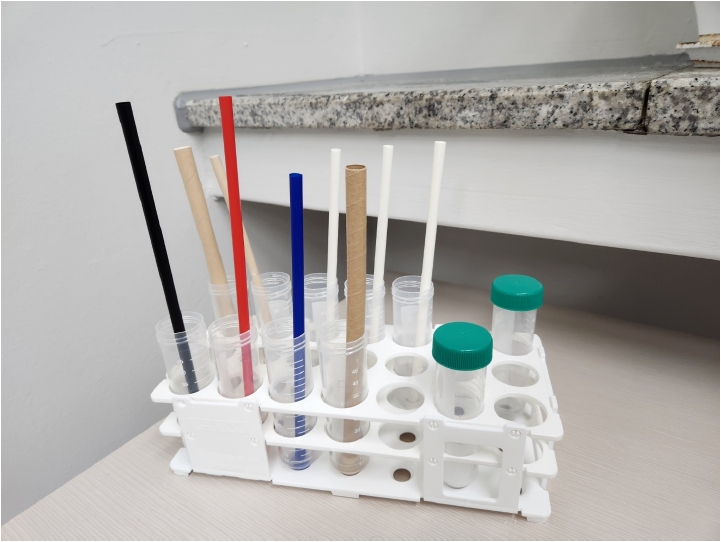
Experimental setup for saliva–straw contact test. Freshly collected human saliva was aliquoted in 4-mL portions into ten polypropylene conical tubes, and nine different commercial drinking straws (six paper and three plastic) were individually inserted into separate tubes and immersed for 10 minutes under static conditions prior to chemical analysis.
Table 1.
Migration of PFAS and phthalates from paper and plastic straws into human saliva under 10-minute static contact conditions
ND denotes no detectable signal, whereas “<LOD” denotes a signal detected but below the LOD. Values below the LOD were replaced with LOD/√2 when calculating means.
PFAS: per- and polyfluoroalkyl substances; PFHxS: perfluorohexane sulfonic acid; PFOA: perfluorooctanoic acid; PFNA: perfluorononanoic acid; PFOS: perfluorooctanesulfonic acid; PFDeA: perfluorodecanoic acid; DBP: di-n-butyl phthalate; DEHP: di(2-ethylhexyl) phthalate; LOD: limit of detection; ND: not detected; SD: standard deviation.
- 1. Timshina A, Aristizabal-Henao JJ, Da Silva BF, Bowden JA. The last straw: characterization of per- and polyfluoroalkyl substances in commercially-available plant-based drinking straws. Chemosphere 2021;277:130238.ArticlePubMed
- 2. Boisacq P, De Keuster M, Prinsen E, Jeong Y, Bervoets L, Eens M, et al. Assessment of poly- and perfluoroalkyl substances (PFAS) in commercially available drinking straws using targeted and suspect screening approaches. Food Addit Contam Part A Chem Anal Control Expo Risk Assess 2023;40(9):1230–41.ArticlePubMed
- 3. Jeon H, Shin YJ, Kim YI, Kim DS, Shin H, Kho Y. Occurrence and composition of PFAS in disposable straws from the Korean market: quantitative and suspect screening analyses. Environ Sci Pollut Res Int 2025;32(44):25291–301.ArticlePubMedPDF
- 4. Cao Y, Lin H, Zhang K, Xu S, Yan M, Leung KM, et al. Microplastics: a major source of phthalate esters in aquatic environments. J Hazard Mater 2022;432:128731.ArticlePubMed
- 5. Aurisano N, Fantke P, Huang L, Jolliet O. Estimating mouthing exposure to chemicals in children’s products. J Expo Sci Environ Epidemiol 2022;32(1):94–102.ArticlePubMedPMCPDF
- 6. Pocas MF, Oliveira JC, Pereira JR, Hogg T. Consumer exposure to phthalates from paper packaging: an integrated approach. Food Addit Contam Part A Chem Anal Control Expo Risk Assess 2010;27(10):1451–9.ArticlePubMed
- 7. U.S. Environmental Protection Agency. Draft Risk Evaluation for Diethylhexyl Phthalate (DEHP). Washington, DC: U.S. Environmental Protection Agency; 2025.
- 8. Geueke B, Groh KJ, Maffini MV, Martin OV, Boucher JM, Chiang YT, et al. Systematic evidence on migrating and extractable food contact chemicals: most chemicals detected in food contact materials are not listed for use. Crit Rev Food Sci Nutr 2023;63(28):9425–35.ArticlePubMed
REFERENCES
Figure & Data
REFERENCES
Citations
Citations to this article as recorded by 
 Cite
Cite XML Download
Migration of phthalates and per- and polyfluoroalkyl substances from paper and plastic drinking straws immersed in human saliva: a pilot migration study
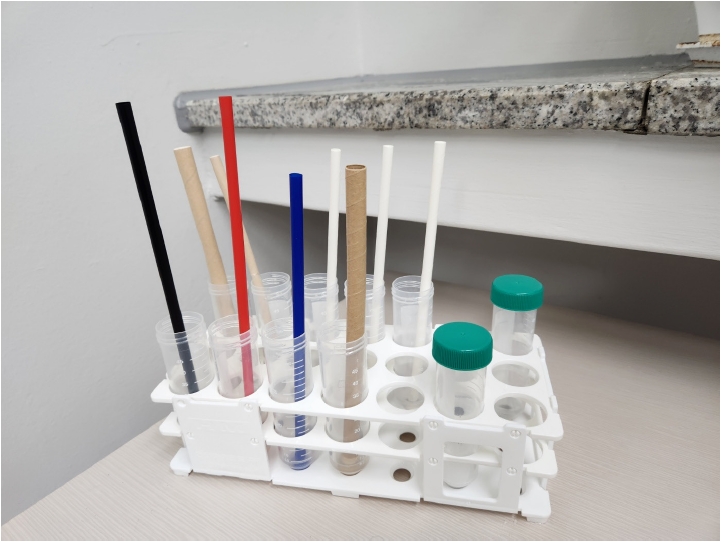
Fig. 1. Experimental setup for saliva–straw contact test. Freshly collected human saliva was aliquoted in 4-mL portions into ten polypropylene conical tubes, and nine different commercial drinking straws (six paper and three plastic) were individually inserted into separate tubes and immersed for 10 minutes under static conditions prior to chemical analysis.
Fig. 1.
Migration of phthalates and per- and polyfluoroalkyl substances from paper and plastic drinking straws immersed in human saliva: a pilot migration study
| Sample | PFAS | Phthalates | ||||||
|---|---|---|---|---|---|---|---|---|
| PFHxS (µg/L) | PFOA (µg/L) | PFNA (µg/L) | PFOS (µg/L) | PFDeA (µg/L) | DBP (µg/L) | DEHP (µg/L) | DBP + DEHP (µmol/L) | |
| LOD | 0.024 | 0.079 | 0.030 | 0.033 | 0.013 | 0.129 | 0.201 | – |
| Blank sample | ND | <LOD | ND | 0.040 | <LOD | <LOD | 14.240 | 0.037 |
| Paper straw | ||||||||
| Paper straw 1 (regular type) | ND | <LOD | ND | <LOD | <LOD | 30.097 | 28.686 | 0.182 |
| Paper straw 2 (regular type) | <LOD | <LOD | <LOD | <LOD | <LOD | 2.584 | 33.280 | 0.094 |
| Paper straw 3 (regular type) | ND | <LOD | <LOD | <LOD | 0.017 | <LOD | 25.746 | 0.066 |
| Paper straw 4 (regular type) | <LOD | <LOD | ND | 0.034 | ND | 4.981 | 5.043 | 0.031 |
| Paper straw 5 (smoothie type) | ND | <LOD | <LOD | <LOD | <LOD | 5.292 | 26.850 | 0.088 |
| Paper straw 6 (smoothie type) | ND | <LOD | <LOD | <LOD | <LOD | 1.840 | 10.955 | 0.035 |
| Mean ± SD | – | – | – | – | – | 7.481 ± 11.251 | 21.760 ± 11.124 | 0.083 ± 0.055 |
| Plastic straw | ||||||||
| Plastic straw 1 | ND | <LOD | <LOD | <LOD | ND | 6.401 | 9.243 | 0.047 |
| Plastic straw 2 | ND | <LOD | <LOD | <LOD | <LOD | 45.974 | 16.245 | 0.207 |
| Plastic straw 3 | <LOD | <LOD | <LOD | <LOD | 0.048 | 0.907 | 9.972 | 0.029 |
| Mean ± SD | – | – | – | – | – | 17.761 ± 24.588 | 11.820 ± 3.849 | 0.094 ± 0.098 |
Table 1. Migration of PFAS and phthalates from paper and plastic straws into human saliva under 10-minute static contact conditions
ND denotes no detectable signal, whereas “<LOD” denotes a signal detected but below the LOD. Values below the LOD were replaced with LOD/√2 when calculating means. PFAS: per- and polyfluoroalkyl substances; PFHxS: perfluorohexane sulfonic acid; PFOA: perfluorooctanoic acid; PFNA: perfluorononanoic acid; PFOS: perfluorooctanesulfonic acid; PFDeA: perfluorodecanoic acid; DBP: di-


