 KSOEM
KSOEM

Articles
- Page Path
- HOME > Ann Occup Environ Med > Volume 38; 2026 > Article
- Original Article Current status and demand projections for occupational and environmental medicine specialists: focus on special health examinations and outsourced occupational health management services
-
Hye-Eun Lee1,2,*
 , Hee-Tae Kang3, Mo-Yeol Kang4, Chungwon Kang5, Kyong Sok Shin6, Hyeon-Taek Heo7, Yong Lim Won8, Jungwon Kim9
 -
Annals of Occupational and Environmental Medicine 2026;38:e23.
DOI: https://doi.org/10.35371/aoem.2026.38.e23
Published online: July 1, 2026
1Department of Social and Preventive Medicine, Hallym University College of Medicine, Chuncheon, Korea
2Institute of Social Medicine, Hallym University College of Medicine, Chuncheon, Korea
3Department of Occupational and Environmental Medicine, Wonju Severance Christian Hospital, Yonsei University Wonju College of Medicine, Wonju, Korea
4Department of Occupational and Environmental Medicine, Seoul St. Mary’s Hospital, College of Medicine, The Catholic University of Korea, Seoul, Korea
5Department of Occupational and Environmental Medicine, Hanil General Hospital, Seoul, Korea
6Sojunghan Industrial Health Institute Corp., Seoul, Korea
7Health Examination Bureau, Korean Industrial Health Association, Daejeon, Korea
8Quality Assurance and Analysis Department, Occupational Safety and Health Research Institute, Ulsan, Korea
9Department of Occupational and Environmental Medicine, Kosin University College of Medicine, Busan, Korea
- *Corresponding author: Hye-Eun Lee Department of Social and Preventive Medicine, Hallym University College of Medicine, 1 Hallimdaehak-gil, Chuncheon 24252, Korea E-mail: heunlee@hallym.ac.kr, heunn.lee@gmail.com
• Received: February 24, 2026 • Revised: June 23, 2026 • Accepted: June 24, 2026
© 2026 Korean Society of Occupational & Environmental Medicine
This is an Open Access article distributed under the terms of the Creative Commons Attribution Non-Commercial License (https://creativecommons.org/licenses/by-nc/4.0/) which permits unrestricted non-commercial use, distribution, and reproduction in any medium, provided the original work is properly cited.


Abstract
-
Background Occupational and environmental medicine (OEM) specialists are key personnel within the occupational health system. Recent developments, such as the introduction of the Serious Accidents Punishment Act and the expansion of occupational health policies targeting vulnerable workers, have highlighted the need to broaden the role of OEM specialists. This study analyzed the current workload of OEM specialists and projected their medium- to long-term demand.
-
Methods The demand for OEM specialists was defined as the actual observed service utilization volume under the current legal, institutional, and policy environment. Key work areas were categorized as special health examinations and outsourced occupational health management services. Data sources included administrative records from the Korea Occupational Safety and Health Agency (KOSHA) and the Ministry of Employment and Labor (MoEL), statistics on worker health examination results, and evaluation data from specialized agencies for occupational health management. Demand through 2035 was projected by applying the observed historical growth trend in service utilization. The required number of specialists was calculated by applying the average workload per specialist in the base year.
-
Results As of 2025, 577 OEM specialists were working at 255 special health examination institutions. Among the 153 occupational health management agencies, 265 physicians were employed, including 133 OEM specialists. The number of workers requiring services from OEM specialists is predicted to continue growing. Applying the current average workload per physician, an additional 132 special health examination physicians and 92 occupational health management agency physicians will be needed by 2035.
-
Conclusions Actual workforce demand may differ from the projections presented in this study depending on changes in policies, industrial structure, service delivery models, and work efficiency. Future studies should incorporate need-based estimates that reflect the diverse roles of OEM specialists and use integrated workforce data to provide more refined projections.
BACKGROUND
Occupational and environmental medicine (OEM) specialists serve as core members of multidisciplinary occupational health teams, assessing work-related risks and designing and advising on systems for preventing occupational diseases and managing worker health.1 These roles are concretized within each country's occupational health system and policy environment, with the scope of duties and emphasis on roles varying according to the institutional context. In Korea, they have functioned as the institutional implementers of worker health management within the framework of the Occupational Safety and Health Act (OSH Act), primarily focusing on special health examinations and health management duties. Particularly since the recent enforcement of the Serious Accidents Punishment Act, which strengthened employers' occupational safety and health responsibilities, social and policy demands for occupational safety and health experts have expanded further.2 The role of OEM specialists is not fixed but is influenced by occupational safety and health laws, systems, and the policy environment. Their scope of work and role composition are continuously restructured in response to policy changes.3,4 This characteristic is commonly observed in countries where occupational health services are closely linked to public policy, suggesting the need to consider the institutional context when discussing the role and demand for OEM specialists.
In Korea, attempts have already been made to systematically estimate the demand and supply of OEM specialists.5,6 These earlier studies presented demand estimation models centered on special health examination institutions and health management agencies, reflecting the industrial structure and legal standards of the time. They analyzed the potential for balancing specialist demand and supply by the target year 2020.6 This approach is practical as it presupposes that demand for OEM specialists is strongly regulated by law and policy, unlike general medical demand, and can empirically demonstrate the required workforce supply-demand balance under the occupational health system at that time.
The environment surrounding occupational health has changed significantly in multiple aspects since the period this study sought to project. The industrial structure has diversified further from a manufacturing-centric base toward services, logistics/transportation, and platform labor.7,8 The scope of hazardous factors subject to special health examinations has expanded, and management methods have continuously evolved. Notably, the demand for special health examinations surged dramatically following the phased introduction of night work examinations over three years starting in 2014.9 Furthermore, factors such as the introduction of the Serious Accidents Punishment Act in 2022, the expansion of occupational health policies targeting vulnerable workers, and increased demand for occupational health in the public sector are influencing the scope of work for OEM specialists. These changes necessitate a reassessment and re-estimation of the demand for OEM specialists from a new perspective.
Meanwhile, for future demand projections, analyzing the current work performance of OEM specialists is essential. Furthermore, a systematic understanding of the current status of specialists is necessary to evaluate the effectiveness of occupational health policies and to monitor and assess the impact of institutional changes. However, in Korea, statistics or data that can regularly capture the scope of work and role distribution of OEM specialists are very limited.
Therefore, this study has the following objectives. First, it aims to analyze the current status of OEM specialists working primarily at designated occupational health institutions to understand current demand. Second, based on this analysis, it seeks to estimate the long-term demand for OEM specialists, reflecting industrial structure and employment outlook. A Korean translation of this article is available in Supplementary Data 1.
METHODS
In estimating the demand for OEM specialists, this study conceptually distinguished between need and demand for medical services. Need refers to the level of medical services deemed desirable for protecting workers' health based on expert judgment, whereas demand refers to the actual requirements arising from service provision and medical utilization under the current legal, institutional, and policy environment.6,10 For OEM specialists, the scope of practice and staffing standards are relatively clearly defined by the OSH Act and related regulations. Therefore, this study adopted a demand estimation approach based on actual service requirements under the current occupational health system. Demand for OEM specialists was defined as the workforce required to meet legally and institutionally mandated services, excluding potential needs based on expert judgment. The demand estimation model was structured by dividing the primary work areas of OEM specialists into two categories: special health examinations and health management services. Special health examinations are regular health screenings conducted for workers exposed to designated hazardous factors under the OSH Act. Outsourced health management service refers to occupational health services provided through occupational health management agencies to workplaces above a certain size, aiming to fulfill workplace occupational health obligations under the same Act.11,12
This study utilized the following administrative data and official statistics to analyze the current status and forecast the demand for OEM specialists.
First, administrative data held by the Ministry of Employment and Labor (MoEL) and Korea Occupational Safety and Health Agency (KOSHA) regarding designated occupational health institutions were used to understand the work performance status and workforce distribution of OEM specialists. This included data on the designation status of special health examination institutions and health management agencies, as well as the specialist allocation status per institution as of 2025. The specialist data was provided in a pseudonymized form to prevent personal identification.
Second, the annual statutory statistics “Results of Worker Health Examinations” and the KOSHA K2B database were used to analyze the scale of workers subject to special health examinations by industry. The K2B database is an electronic reporting system through which occupational health institutions, including special health examination institutions and occupational health management agencies, submit information on service activities and operational status.
Third, we utilized the pre-input data from KOSHA’s triennial evaluation of occupational health management agencies to determine the number of workplaces and workers each agency covers.
Fourth, to reflect industrial structure and employment outlook, we referenced statistics on the number of employed persons by industry and medium-to-long-term employment outlook data provided by Statistics Korea and related agencies.
Special health examination demand
The analysis was conducted in the following steps.
First, industry- and year-specific data on workers undergoing special health examinations from 2017 to 2023 were obtained from the “Worker Health Examination Results Report.” Industry-specific participation rates were calculated by dividing the number of examinees by the number of employed workers in each industry.13 Data prior to 2017 were excluded due to structural changes following the introduction of special health examinations for night work.14
Second, assuming that post-2017 participation trends would continue, industry-specific participation rates for 2025–2035 were projected using simple linear regression models with year as the explanatory variable.
Third, the projected number of workers subject to special health examinations was estimated by applying the projected participation rates to industry-specific employment projections from the Korea Employment Information Service (KEIS)15 and summing across industries.
Number of workers for special health examinations in future years = ∑(Projected employment by industry × Projected examination rate by industry)
Fourth, the average annual number of examinations per specialist was calculated using 2024 examination data and the number of specialists employed at examination institutions. This value was applied to future examination volumes to estimate the required number of specialists.
Finally, sensitivity analysis was conducted. The base scenario assumed continuation of past trends, while high and low scenarios reflected ±10% changes in participation rates to account for potential policy strengthening or reductions in exposed workers due to automation and workplace improvements.
Outsourced health management service
Estimating demand for outsourced health management services differs from special health examinations due to the lack of regularly published official statistics on the number of workers managed by occupational health management agencies. Accordingly, this study estimated demand using administrative data submitted during the health management agency evaluation process implemented since 2018, with the number of workers covered from 2020 to 2024 used as baseline data.
Demand was estimated using the proportion of workers managed by health management agencies relative to total employment as the key indicator. This ratio increased from 7.3% in 2020 to 8.5% in 2024, likely reflecting recent occupational safety and health policy changes, including the expansion of the Serious Accidents Punishment Act. However, due to the absence of comparable pre-policy data, the magnitude of the policy effect could not be quantitatively isolated.
To address this uncertainty, two demand projection scenarios were applied.
In the continuous growth scenario (scenario 1), future coverage ratios were projected using a simple linear regression model with calendar year as the independent variable and the coverage ratio as the dependent variable based on data from 2020 to 2024. The projected ratios were then applied to the projected number of employed persons provided by the KEIS.
Projected number of workers covered by occupational health management services = Projected total employment × Projected coverage ratio
In the plateau scenario (scenario 2), the coverage ratio observed in 2024 (8.5%) was assumed to remain constant through 2035. The projected number of workers covered was estimated by applying the 2024 coverage ratio to the future projected number of employed persons provided by the KEIS.
Projected number of workers covered by occupational health management services = Projected total employment × Coverage ratio in 2024 (8.5%)
Sensitivity analysis was conducted for both scenarios using ±10% of the estimated coverage ratios. Finally, the demand for OEM specialists was calculated by applying the base-year (2024) average number of workers managed per specialist to the projected number of workers subject to outsourced health management.
This study used secondary administrative data that were fully anonymized and contained no personally identifiable information. According to relevant regulations, institutional review board (IRB) approval and informed consent were not required.
RESULTS
According to data provided by the MoEL, as of 2025, 577 special health examination physicians were working at 255 special health examination institutions. Considering the designation standard for these institutions, all were considered OEM specialists. There were 153 health management agencies employing 265 physicians. Among these, 133 (50.2%) were estimated to be OEM specialists. The status of physicians serving as health managers or Occupational Medicine Physicians was difficult to ascertain precisely due to incomplete data. The number of OEM specialists working in the public sector was very limited. Forty OEM specialists worked at hospitals under the Workers' Compensation and Welfare Service (COMWEL), of whom 24 were engaged in work-relatedness evaluation, rather than special health examinations or outsourced health management service. As research or policy institutions, KOSHA had one preventive medicine specialist as of 2025, while the COMWEL Occupational Safety & Health Research Institute had one preventive medicine specialist and one OEM specialist.
According to the KOSHA K2B database, a total of 2,765,337 workers underwent special health examinations in 2024. However, this figure included examinations conducted by general physicians at institutions designated for night-work special health examinations. Therefore, to estimate the workload of OEM specialists, we used the number of special health examinations performed by OEM specialists (2,747,619). Dividing this number by the 577 OEM specialists engaged in special health examinations as of 2025 yielded an average annual workload of 4,762 examinations per specialist.
To more precisely assess the workload of OEM specialists, an analysis was conducted targeting special health examination institutions for which both examination data and personnel data were available for each institution. The analysis covered a total of 247 institutions and 566 physicians. Dividing each institution's 2024 special health examination performance by the number of physicians affiliated with that institution in 2025 yielded an average of 4,539 special health examinations per physician per year (standard deviation 3,172), showing little difference from the previous simple calculation. When institutions were categorized by the number of special health examinations per physician, those handling 5,001–10,000 examinations accounted for the largest proportion (39.3%). Institutions in the 3,001–5,000 range comprised 29.6%, followed by those handling 1,001–3,000 examinations (21.1%) (Table 1). The distribution of the number of examinees per physician according to institution location and size (defined by the number of physicians working in special health examination institutions) is presented in Supplementary Table 1 and Supplementary Fig. 1.
Based on 2024 K2B data, occupational health management agencies managed 23,466 workplaces, with an estimated 2,436,163 workers under their care. There were 265 physicians as of 2025. Based on this, the average number of physicians per institution was 1.7, with each physician managing an average of 88.6 workplaces and 9,193 workers.
The number of individuals undergoing special health examinations in 2035 is projected to reach approximately 3.38 million. Sensitivity analyses yielded a lower-bound estimate of about 3.04 million and an upper-bound estimate of approximately 3.72 million. When these projections were translated into current physician workload using the observed average annual workload per physician (4,762 examinations), an estimated 709 OEM specialists would be required to meet the demand for special health examinations in 2035. This corresponds to an additional requirement of 132 physicians compared with the current workforce of 577 (Table 2, Fig. 1).
Under the continuous growth scenario (scenario 1) for health management agency demand, the number of workers covered by these institutions in 2035 is projected to reach approximately 3.28 million. Sensitivity analyses yielded a lower-bound estimate of about 2.95 million and an upper-bound estimate of approximately 3.61 million. When these projections were translated into physician workload using the observed average annual workload per physician in 2024 (9,193 workers), an estimated 357 physicians would be required in health management agencies by 2035. This corresponds to an additional requirement of 92 physicians compared with the current workforce of 265 (Table 3, Fig. 2).
Under the plateau scenario (scenario 2), the number of workers covered by health management agencies in 2035 is projected to be approximately 2.45 million. Sensitivity analyses yielded a lower-bound estimate of about 2.20 million and an upper-bound estimate of approximately 2.69 million. When these projections were translated into physician workload using the observed average annual workload per physician (9,193 workers), an estimated 266 physicians would be required in health management agencies by 2035. This represents a marginal increase of one physician compared with the current workforce of 265 (Table 4, Fig. 3).
DISCUSSION
This study analyzed the current workload of OEM specialists and projected long-term demand based on the actual service levels required under the current occupational health system. The analysis estimated that the number of workers subject to special health examinations and outsourced occupational health management services will continue to increase in the future. Applying this projected service volume to the average workload per physician observed in 2024 indicates that a greater number of OEM specialists will be required by 2035 compared to the present.
Analysis of the current work patterns of OEM specialists indicated that their activities were largely concentrated in special health examinations and health management services, with very limited involvement in the public sector or in research and policy-related functions. OEM recognizes work and environment as key social determinants of health. OEM specialists are trained in multiple disciplines—including epidemiology, toxicology, industrial hygiene, risk assessment, public health, legislation and systems, and organizational management—enabling them to perform core roles across diverse sectors such as industry, hospitals, academia, government agencies, insurance, and public health.16 However, the current activities of OEM specialists in Korea are concentrated primarily in legally mandated special health examinations and outsourced occupational health management services, suggesting that the broader expertise of OEM specialists in prevention, policy, and coordination is not being fully utilized. This may reflect not a lack of social or institutional demand for these roles, but rather the relative scarcity of stable positions and career pathways in public-sector roles, research and policy, and workplace-based preventive activities. In addition, rewards, working conditions, professional autonomy, the scope of roles and responsibilities, opportunities for advancement and professional development, and the hiring structures and budget constraints of relevant institutions may all have limited entry into these fields. Furthermore, the limited role of OEM specialists in the public sector suggests weaknesses in equity and accessibility of occupational health services. Beyond the private-sector-centered delivery model, a public role targeting small workplaces and vulnerable workers should be considered.
The demand forecast in this study explored the scale and direction of occupational health services required in the long term, assuming the current occupational health system and service delivery methods continue following past trends. We found that despite the possibility of future employment stagnation or slight decline, demand for both services is projected to remain above a certain level, assuming the observed growth trend in special health examinations and outsourced health management services continues.
According to the KEIS's future labor supply and demand outlook, while the total number of employed persons, which has been steadily increasing, is expected to enter a decline phase after 2028, different patterns of change are observed across industries.15 While employment declines are projected in traditional industries such as manufacturing, construction, and wholesale/retail trade, employment growth is expected to continue in sectors like health and social welfare services, information and communications, and professional, scientific, and technical services. These shifts in industrial structure are likely to impact demand for special health examinations and outsourced health management services.17 Considering that, as of 2023, a significant proportion of workers subject to mandatory health examinations is concentrated in manufacturing (48.9%) and construction (13.0%), employment declines in these sectors could lead to a reduction in the number of workers requiring special health examinations. Conversely, employment in health and social welfare services is projected to increase significantly due to population aging, potentially boosting demand for special health examinations and outsourced health management services. To reflect these industrial structure changes, this study applied trends based on industry-specific examination rates to forecast special health examinations.
Demand for OEM specialists was calculated by dividing the projected service volume by the current workload per specialist. However, the average workload per physician may also increase. Indeed, past research indicates that the number of special health examinations per physician was 3,819 in 2008, increasing by approximately 25% over 16 years to 4,762 in 2024, as confirmed in this study.6 Notably, analysis of special health examination workloads revealed significant variation in workload per physician between institutions. Approximately 30% of institutions have an annual special health examination workload of 3,000 individuals or less per physician, which is far below the designation limit of 10,000 individuals per physician per year mandated by the OSH Act. When the current regulatory designation criterion of 10,000 special health examinations per physician per year is applied, the estimated number of physicians required in 2035 is approximately 338, which is lower than the current number of OEM specialists engaged in special health examinations (n = 577). Considering this finding, the projected future demand for additional OEM specialists may reflect differences in workload utilization and service delivery models across institutions or the maldistribution of physicians across institutions or regions. Therefore, future workforce policies should place greater emphasis on improving the allocation of the existing workforce and reducing regional disparities.
Technology innovation can also influence the provision of occupational health services.18 Reducing non–special health examination duties and improving efficiency through digitalization and artificial intelligence could allow OEM specialists to handle more examinees per physician. In such a scenario, future demand could be lower than the demand calculated in this study. Furthermore, the results of this study are based on the assumption that the current system and service delivery methods remain unchanged. The required workforce size could vary depending on changes in the manner of conducting health examinations or the operation of the system.
Meanwhile, one of the most significant limitations identified during this study is the extremely weak integrated data foundation for systematically understanding the workforce and service provision status of Occupational Medicine Physicians. While some administrative data are available—primarily from specialized health examination institutions and occupational health management agencies—key personnel information, including actual activity status, scope of work, specialty, concurrent appointments, and inter-institutional mobility, is not consistently managed or updated. This creates constraints in accurately determining the scale and role distribution of currently active OEM specialists. Of particular concern are occupational health managers and Occupational Medicine Physicians, whose roles are legally designated, yet for whom data reliability is extremely low, making it difficult to accurately ascertain workforce status. To enhance the effectiveness of occupational health workforce policies, a centralized data management system covering the entire occupational health workforce, including OEM specialists, is needed. Beyond simple headcounts, such a system should track activity areas, work patterns, and inter-institutional mobility, enabling periodic updates of demand forecasts and more accurate assessment of policy-driven demand–supply changes.
This study used available administrative data and public statistics, aiming for demand-based forecasting. This process has several limitations. First, future demand was estimated based on actual service utilization under the current legal, institutional, and policy environment. Consequently, potential needs based on expert judgment were not reflected. Accordingly, the estimates presented in this study reflect policy-driven demand under the current system and do not represent the optimal workforce size required to maximize the effectiveness of occupational health services. The projected demand may therefore be lower than estimates derived from a broader need-based approach that incorporates the full range of roles performed by OEM specialists. Future studies should consider both need-based estimates and potential changes in demand resulting from policy changes.
Second, demand forecasting was based on extrapolating past service volume trends. For special health examinations, we used data from 2017 onward, after the phased introduction of special health examinations for night work had been fully implemented (2014–2016), to minimize the influence of the initial policy-driven expansion. However, the effects of this policy change may have persisted beyond 2017. In addition, if participation rates for special health examinations stabilize over time, the projected demand in this study may overestimate future workforce requirements.
Third, future workforce demand was estimated using the average workload per physician observed in the base year. However, substantial variation in workload was observed across institutions, and low workloads in some institutions may reflect differences in utilization or maldistribution of the workforce across institutions or regions. Therefore, the projected demand in this study may have been somewhat overestimated.
Fourth, the average workload per physician was estimated based on observations from a single point in time and therefore did not account for future changes in regulations, restructuring of occupational health services, or changes in work practices. In addition, the time and effort required to conduct special health examinations may vary across industries, and changes in industrial structure may therefore affect the actual workload per physician. Furthermore, reforms to the special health examination system, qualitative enhancement of occupational health management services, and changes in work efficiency resulting from digital technologies and artificial intelligence may substantially affect future service capacity and workforce demand, but these factors could not be quantitatively incorporated into the present analysis. Accordingly, the actual future workforce demand may differ from the projections presented in this study.
Lastly, this study relied on available administrative and publicly disclosed data, which limited demand estimation for some occupational health service areas. Physicians serving as health managers or Occupational Medicine Physicians were excluded due to the lack of systematic data. In addition, workforce data were available only for 2025, whereas service performance data were limited to 2024, resulting in temporal inconsistencies in workload calculations. Consequently, given the increasing workload trend, the average workload per physician may have been slightly underestimated.
Nevertheless, this study is significant in that it systematically presents the current workload and long-term demand for OEM specialists by maximizing the use of available data. These findings provide foundational evidence for future occupational health workforce policy discussions, as well as for efforts to redefine the role of OEM specialists and restructure occupational health service delivery.
CONCLUSIONS
This study provides updated estimates of the current workload and future demand for OEM specialists in Korea. Demand may increase under the current occupational health system, although future workforce needs will depend on policy, service delivery, and work efficiency. More comprehensive workforce data and need-based projections are warranted.
Abbreviations
COMWEL
Workers' Compensation and Welfare Service
KEIS
Korea Employment Information Service
KOSHA
Korea Occupational Safety and Health Agency
MoEL
Ministry of Employment and Labor
OEM
occupational and environmental medicine
OSH Act
Occupational Safety and Health Act
-
Funding
This research was supported by the Occupational Safety and Health Research Institute (2025-OSHRI-1923) and the Korean Society of Occupational and Environmental Medicine, funded by the Korea Occupational Safety and Health Agency.
-
Competing interests
Mo-Yeol Kang and Jungwon Kim, contributing editors of the Annals of Occupational and Environmental Medicine, were not involved in the editorial evaluation or decision to publish this article. All remaining authors have declared no conflicts of interest.
-
Author contributions
Conceptualization: Lee HE, Kim J. Data curation: Lee HE, Kang C, Shin KS, Heo HT, Won YL. Methodology/formal analysis/validation: Lee HE, Kang HT, Kang MY, Kang C, Shin KS, Heo HT. Project administration: Lee HE, Won YL, Kim J. Funding acquisition: Kim J. Writing - original draft: Lee HE. Writing - review & editing: Lee HE, Kang HT, Kang MY, Kang C, Shin KS, Heo HT, Won YL, Kim J.
NOTES
SUPPLEMENTARY MATERIAL
Supplementary Data 1.
Korean translation of "Current status and demand projections for occupational and environmental medicine specialists: focus on special health examinations and outsourced occupational health management services."
Supplementary Table 1.
Number of examinees by institution size, defined by the number of special health examination physicians.
Supplementary Fig. 1.
Number of examinees per physician by institution location.
Fig. 1.
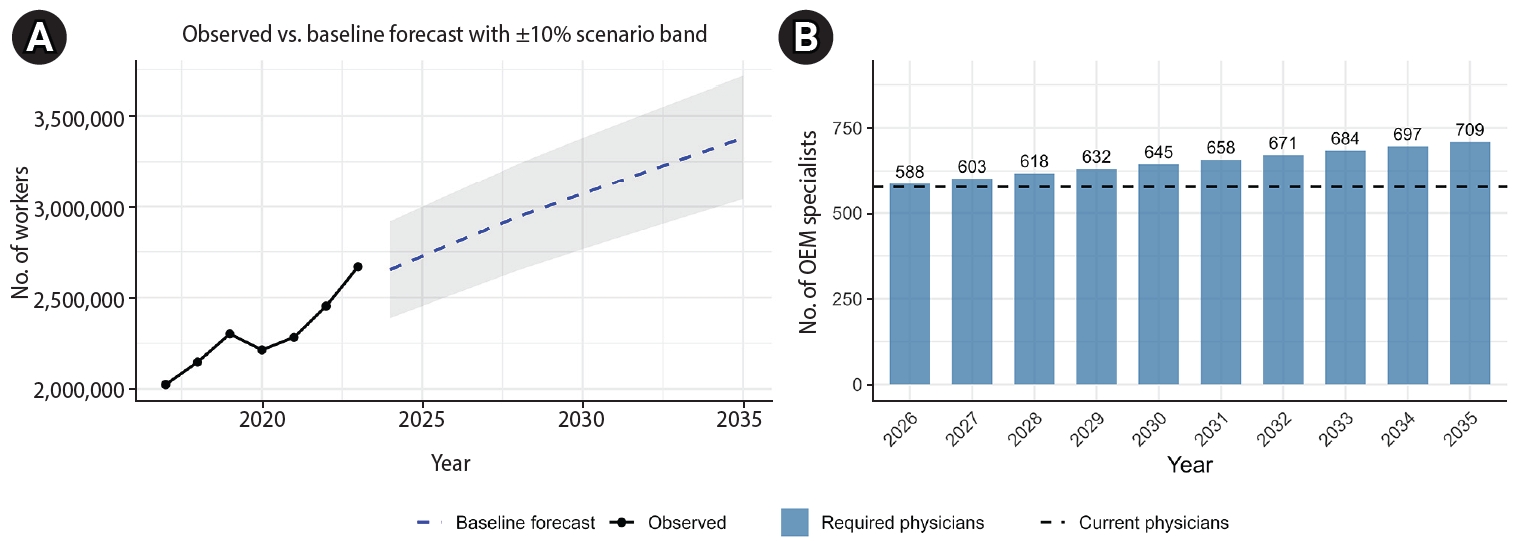
Observed (2017–2024) and projected (2025–2035) number of workers undergoing special health examinations and required occupational and environmental medicine (OEM) specialists. (A) Projected number of workers. (B) Projected number of required OEM specialists.
Fig. 2.
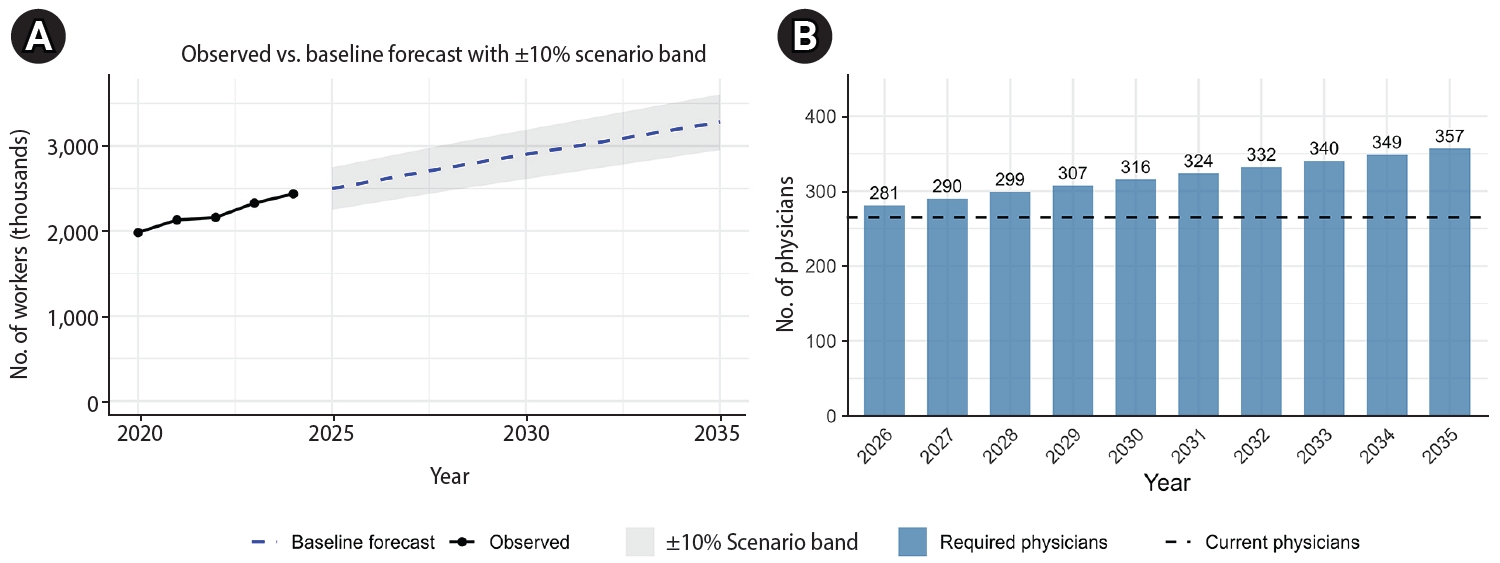
Observed (2020–2024) and projected (2025–2035) number of workers covered by outsourced occupational health management services and required physicians (scenario 1). (A) Projected number of workers. (B) Projected number of required physicians.
Fig. 3.
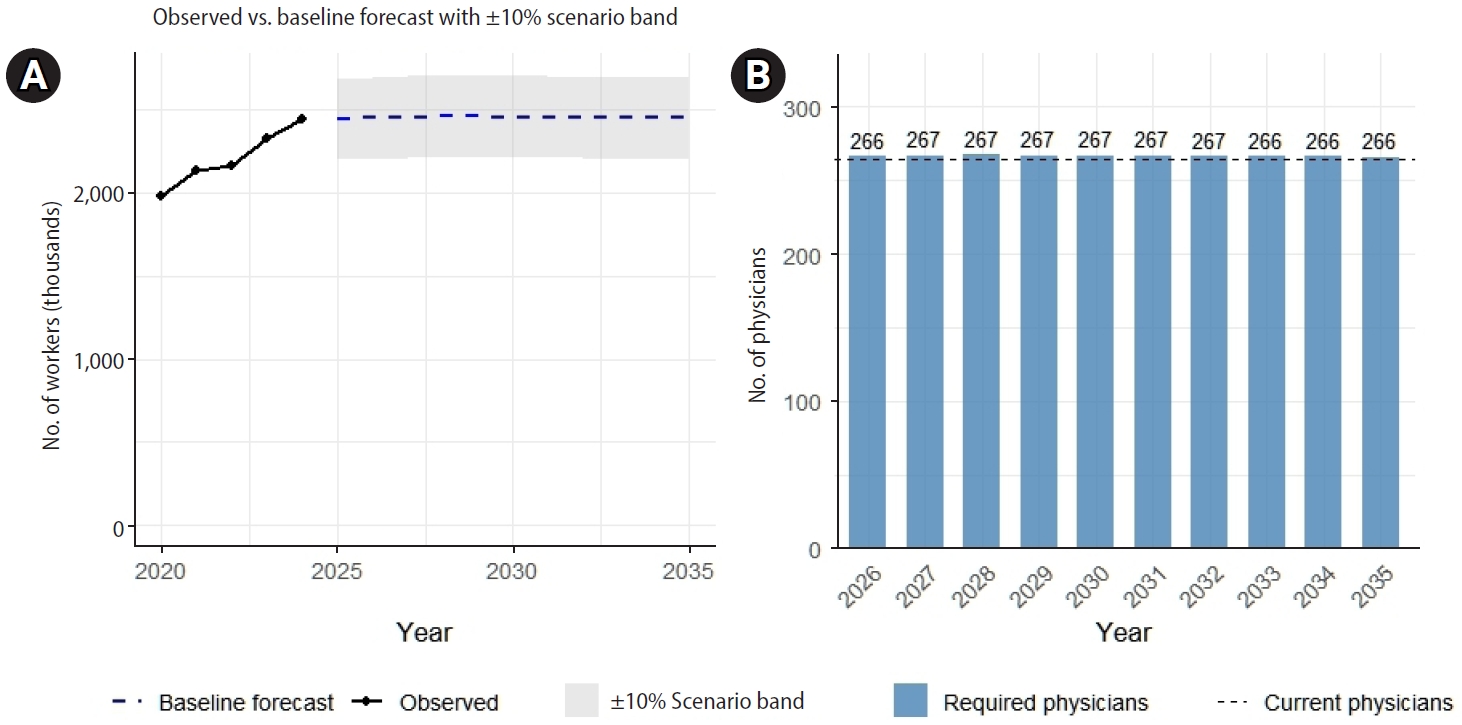
Observed (2020–2024) and projected (2025–2035) number of workers covered by outsourced occupational health management services and required physicians (scenario 2). (A) Projected number of workers. (B) Projected number of required physicians.
Table 1.
Special health examination workload per physician across institutions
| No. of special health examinations per physician | No. of institutions (%) |
|---|---|
| ≤1,000 | 20 (8.1) |
| 1,001–3,000 | 52 (21.1) |
| 3,001–5,000 | 73 (29.6) |
| 5,001–10,000 | 97 (39.3) |
| ≥10,001 | 5 (2.0) |
| Total | 247 (100) |
Table 2.
Projected demand for special health examinations (number of workers, 2025–2035)
Table 3.
Projected demand for health management services (scenario 1a) (number of workers, 2025–2035)
Table 4.
Projected demand for health management services (scenario 2a) (number of workers, 2025–2035)
- 1. MacDonald E, Baranski B, Wilford J. Occupational Medicine in Europe: Scope and Competencies. Copenhagen, Denmark: WHO Regional Office for Europe; 2000.
- 2. Park S. Safety and health manager workforce supply fails to meet on-site demand. Gyeongnam Domin Ilbo; 2024 Mar 6.
- 3. Eisch E, Kuper P, Lindert L, Choi KE. Working conditions of occupational physicians: a scoping review. Int J Environ Res Public Health 2022;19(10):6222.ArticlePubMedPMC
- 4. Verger P, Pardon C, Dumesnil H, Charrier D, De Labrusse B, Lehucher-Michel MP, et al. Occupational physicians' attitudes and practices in relation to occupational cancer prevention: a qualitative study in southeastern France. Int J Occup Environ Health 2010;16(3):320–9.ArticlePubMed
- 5. Kim J, Chae Y, Leem J. Estimation of demand and supply for occupational and environmental medicine specialties in Korea (I): estimation of supply. Korean J Occup Environ Med 2011;23(1):71–9.ArticlePDF
- 6. Chae Y, Kim J, Leem J. Estimation of demand and supply for occupational and environmental medicine specialties in Korea (II): demand estimation and demand-supply balance. Korean J Occup Environ Med 2011;23(1):80–8.ArticlePDF
- 7. Yoo H, Yang M, Song JH, Yoon JH, Lee W, Jang J, et al. Investigation of working conditions and health status in platform workers in the Republic of Korea. Saf Health Work 2024;15(1):17–23.ArticlePubMedPMC
- 8. Kang D. Problems and suggested improvement plans for occupational health service in Korea. Ann Occup Environ Med 2023;35:e10.ArticlePubMedPMCPDF
- 9. Ministry of Employment and Labor. Number of workers receiving health examinations by hazardous factor and age group. http://kosis.kr/statHtml/statHtml.do?orgId=118&tblId=DT_11809_N024&tmprScrId=20260716230204486_ad064696494543e8. Updated 2026. Accessed January 27, 2026..
- 10. Castorina JS, Rosenstock L. Physician shortage in occupational and environmental medicine. Ann Intern Med 1990;113(12):983–6.ArticlePubMedPDF
- 11. Won YL, Ko KS, Park JO, Choi YJ, Lee H, Sung JM, et al. Achievements, problems, and future direction of the quality control program for special periodic health examination agencies in Republic of Korea. Saf Health Work 2019;10(1):125–9.ArticlePubMedPMC
- 12. Lee S, Myong JP, Kim EA, Eom H, Choi B, Kang YJ. Practice status of specialized agencies for occupational health management of small- to medium-size enterprises and the factors improving their performance: a cross-sectional survey study. Ann Occup Environ Med 2017;29:4.ArticlePubMedPMCPDF
- 13. Statistics Korea. Business demography administrative statistics: number of employees by industry (establishments with one or more regular employees). https://kosis.kr/statHtml/statHtml.do?orgId=101&tblId=DT_5BD1002&conn_path=I2. Updated 2024. Accessed January 25, 2026.
- 14. Park WJ. Night work and its health effects: focusing on the relevant laws and regulations of the Republic of Korea. J Sleep Med 2021;18(1):1–11.Article
- 15. Korea Employment Information Service. Medium- and Long-term Manpower Supply and Demand Outlook, 2023-2033. Basic Research Report No. 2024-36. Eumseong, Korea: Korea Employment Information Service; 2024.
- 16. Green-McKenzie J, Khan A, Redlich CA, Margarin AR, McKinney ZJ. The future of occupational and environmental medicine. J Occup Environ Med 2022;64(12):e857–63.ArticlePubMed
- 17. Franco G. The role of the occupational physician in the enlarged European Union: challenges and opportunities. Occup Med (Lond) 2006;56(3):152–4.ArticlePubMed
- 18. Koh D, Tan A. Applications and impact of Industry 4.0: technological innovations in occupational safety and health. Saf Health Work 2024;15(4):379–81.ArticlePubMedPMC
REFERENCES
Figure & Data
REFERENCES
Citations
Citations to this article as recorded by 
- Korean occupational and environmental medicine specialists: demand-supply projections
Hee-Tae Kang, Hye-Eun Lee, Mo-Yeol Kang, Chungwon Kang, Kyong-sok Shin, Hyeon-Taek Heo, Yong Lim Won, Jungwon Kim
Annals of Occupational and Environmental Medicine.2026; 38: e34. CrossRef
 Cite
Cite XML Download
Current status and demand projections for occupational and environmental medicine specialists: focus on special health examinations and outsourced occupational health management services
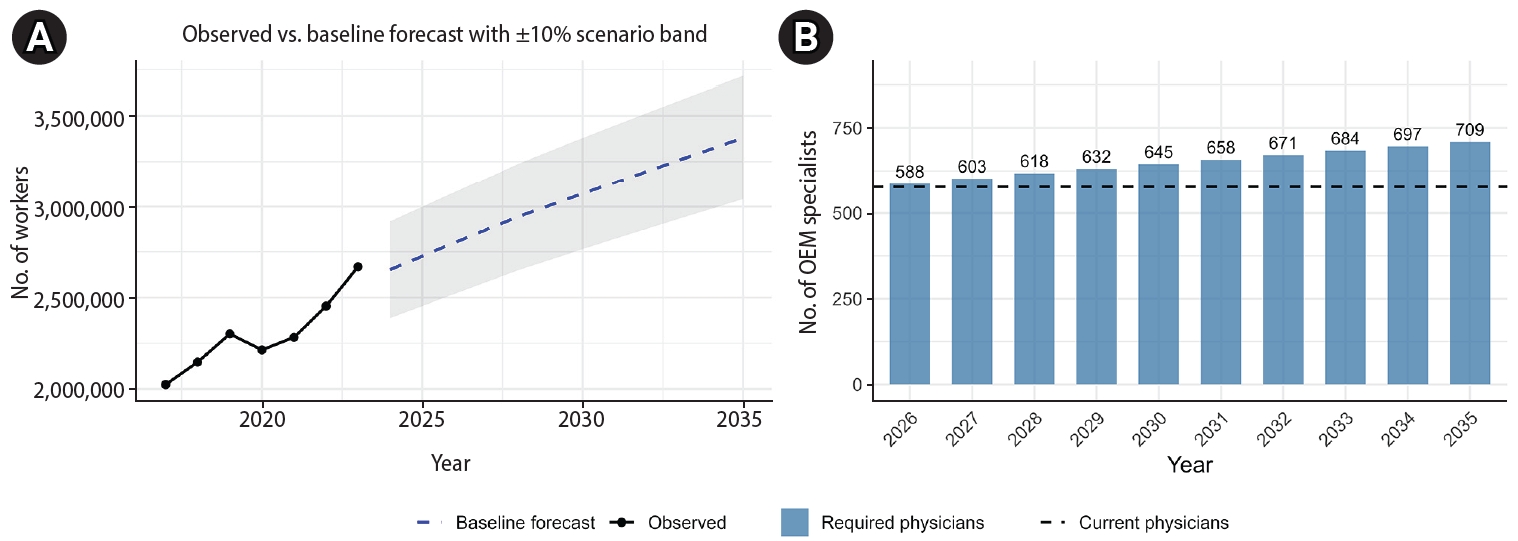
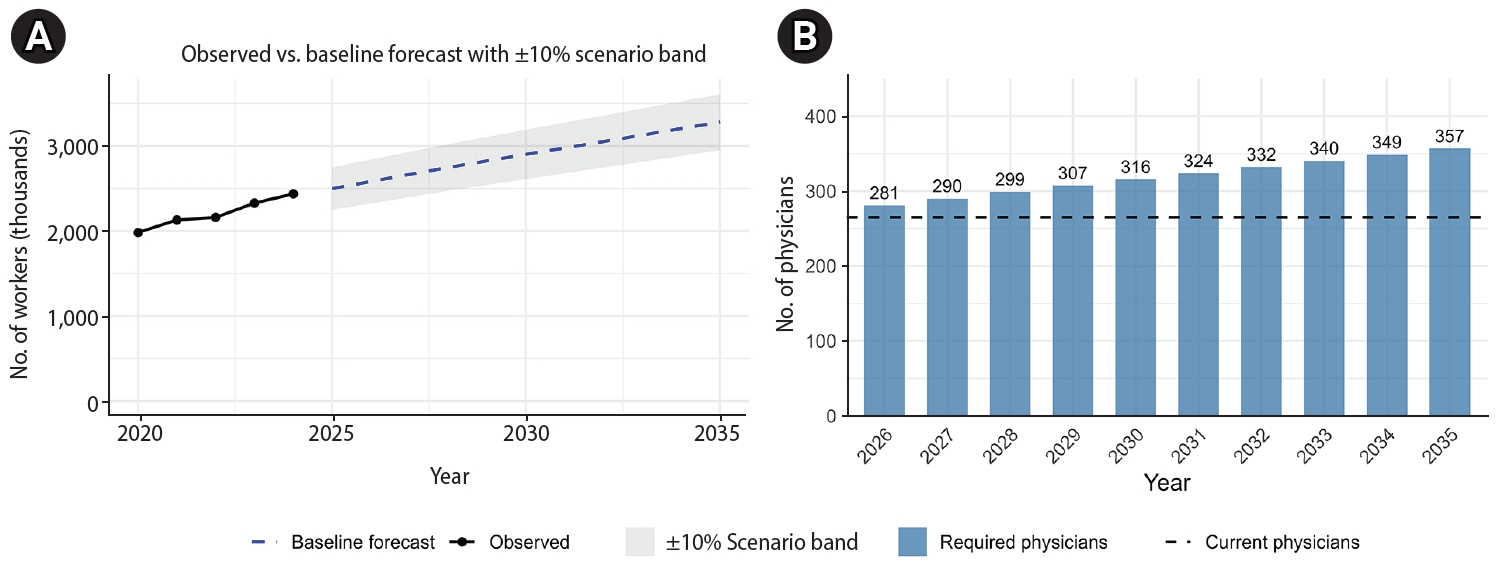
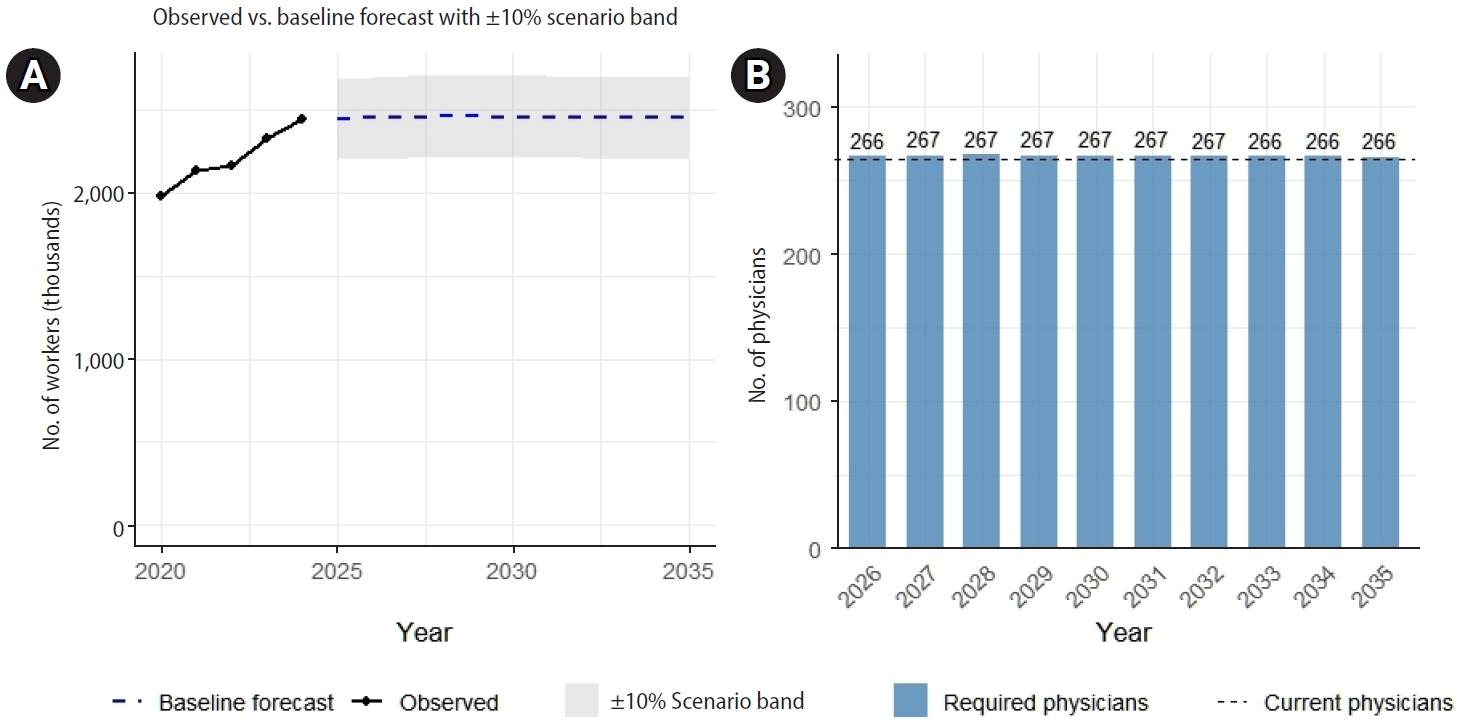
Fig. 1. Observed (2017–2024) and projected (2025–2035) number of workers undergoing special health examinations and required occupational and environmental medicine (OEM) specialists. (A) Projected number of workers. (B) Projected number of required OEM specialists.
Fig. 2. Observed (2020–2024) and projected (2025–2035) number of workers covered by outsourced occupational health management services and required physicians (scenario 1). (A) Projected number of workers. (B) Projected number of required physicians.
Fig. 3. Observed (2020–2024) and projected (2025–2035) number of workers covered by outsourced occupational health management services and required physicians (scenario 2). (A) Projected number of workers. (B) Projected number of required physicians.
Fig. 1.
Fig. 2.
Fig. 3.
Current status and demand projections for occupational and environmental medicine specialists: focus on special health examinations and outsourced occupational health management services
| No. of special health examinations per physician | No. of institutions (%) |
|---|---|
| ≤1,000 | 20 (8.1) |
| 1,001–3,000 | 52 (21.1) |
| 3,001–5,000 | 73 (29.6) |
| 5,001–10,000 | 97 (39.3) |
| ≥10,001 | 5 (2.0) |
| Total | 247 (100) |
| Year | Baseline | Low-end | High-end |
|---|---|---|---|
| 2025 | 2,726,595 | 2,453,936 | 2,999,255 |
| 2026 | 2,799,707 | 2,519,736 | 3,079,678 |
| 2027 | 2,872,286 | 2,585,058 | 3,159,515 |
| 2028 | 2,944,333 | 2,649,900 | 3,238,766 |
| 2029 | 3,008,259 | 2,707,433 | 3,309,085 |
| 2030 | 3,071,540 | 2,764,386 | 3,378,694 |
| 2031 | 3,134,177 | 2,820,760 | 3,447,595 |
| 2032 | 3,196,171 | 2,876,554 | 3,515,788 |
| 2033 | 3,257,520 | 2,931,768 | 3,583,272 |
| 2034 | 3,318,225 | 2,986,402 | 3,650,047 |
| 2035 | 3,378,286 | 3,040,457 | 3,716,114 |
| Year | Baseline | Low-end | High-end |
|---|---|---|---|
| 2025 | 2,499,398 | 2,249,458 | 2,749,338 |
| 2026 | 2,582,133 | 2,323,920 | 2,840,346 |
| 2027 | 2,665,188 | 2,398,670 | 2,931,707 |
| 2028 | 2,748,564 | 2,473,708 | 3,023,420 |
| 2029 | 2,824,780 | 2,542,302 | 3,107,258 |
| 2030 | 2,900,904 | 2,610,814 | 3,190,995 |
| 2031 | 2,976,937 | 2,679,243 | 3,274,630 |
| 2032 | 3,052,877 | 2,747,589 | 3,358,165 |
| 2033 | 3,128,725 | 2,815,853 | 3,441,598 |
| 2034 | 3,204,482 | 2,884,034 | 3,524,930 |
| 2035 | 3,280,147 | 2,952,132 | 3,608,161 |
| Year | Baseline | Low-end | High-end |
|---|---|---|---|
| 2025 | 2,441,215 | 2,197,093 | 2,685,336 |
| 2026 | 2,446,266 | 2,201,639 | 2,690,892 |
| 2027 | 2,451,317 | 2,206,185 | 2,696,449 |
| 2028 | 2,456,368 | 2,210,731 | 2,702,005 |
| 2029 | 2,454,919 | 2,209,427 | 2,700,411 |
| 2030 | 2,453,470 | 2,208,123 | 2,698,817 |
| 2031 | 2,452,020 | 2,206,818 | 2,697,222 |
| 2032 | 2,450,571 | 2,205,514 | 2,695,628 |
| 2033 | 2,449,122 | 2,204,210 | 2,694,034 |
| 2034 | 2,447,672 | 2,202,905 | 2,692,440 |
| 2035 | 2,446,223 | 2,201,601 | 2,690,846 |
Table 1. Special health examination workload per physician across institutions
Table 2. Projected demand for special health examinations (number of workers, 2025–2035)
Table 3. Projected demand for health management services (scenario 1a) (number of workers, 2025–2035)
Continuous demand growth scenario.
Table 4. Projected demand for health management services (scenario 2a) (number of workers, 2025–2035)
The plateau scenario.


